I've been wanting to do a review of this wonderful bush tool since ordering one on a fluke from Cold Steel last year for the ridiculous closeout price of only $7.00. I had never heard of a "Barong" machete and to be honest, the name was rather off-putting and strange to me, since I'm more of a bushcrafter than a tactical gear person. The blade shape looked useful and for only $7.00, I decided to order one to see what it was like.
What I found (to my utter suprise) was a machete that was basically a Cold Steel Bushman on steroids but with a quality, fit and finish that seemed more like a knife costing $40-$50. Needless to say, I was pretty blown away. After using the tool for the better part of a year here in the mountains, my initial impression has only grown more favorable. Since I had already owned a Cold Steel Bushman, I was struck by the fact that the Barong machete seemed more or less like a bigger version of the Bushman, so after a long winter, I wanted to post this review with that in mind.
Cold Steel 12" Barong Machete specs:
- 12" Blade length
- Overall Length 17.75"
- Weight without sheath (as measured on a digital postal scale)- 16.9 ounces
- Weight with sheath- 22.3 ounces
- Blade steel- 1055 Carbon Steel
- Price- Now discontinued, though some can be found on the aftermarket for $25-$50
The Barong when it was new. This photo was taken last year when the weather was still warm (ahhhhh!). Note the Cold Steel logo stamped into the machete which is conspicuously absent on South African made Cold Steel machetes (like the Kukri Machetes, for instance).

Unlike the Kukri Machete, the Chinese-manufactured Barong machete sports a higher quality sheath, with thick Cordura material similar to the Bushman's sheath. My Cold Steel Kukri Machete's flimsy sheath literally ripped open after only my first outing, but the Barong's sheath has easily handled almost a year of bush trekking with no problems. It holds the machete securely and also hangs low enough to clear a backpack strap, a big plus for me since I backpack quite a bit. I like cordura over leather for this application as it is lighter than a comparable leather sheath yet still holds the tool safely and securely.
The fit and finish of the blade is also higher than the Kukri's and this particular one came with a fairly sharp edge right out of the package. The handle material is also of higher quality, being much softer than the rather hard plastic of the Kukri and similar to the feel of the Kraton rubber on Cold Steel's vaunted SRK knife. The handle is just about perfect and it's one of the things that make this machete such a pleasure to use.
The steel is 1055 Carbon Steel, which is commonly used in machetes as well as Cold Steel's line of axes and tomahawks. It's not the greatest in edge retention but makes up for it in toughness and ease of sharpening. This machete will easily get hair shaving sharp with no effort, whereas my Kukri machete took quite a bit of work to reach this point due to the rough factory grind. It comes stock with a very efficient Scandi grind profile, similar to what the Swedish Mora Knives have. This makes it an excellent cutting tool.
Though these machetes are built really tough, you'll need to be a little more careful when using them around rocks and tree knots due to the thinner Scandi grind edge. That said, it is easily fixed in the field with a file and some 220 grit sandpaper. If you have the know-how, I'd also recommend that this edge be converted into a tougher convex edge at some point, like the edge on axes and hatchets.
PART TWO- The Bushman vs the 12" Barong
(Comparison view of the Bushman, Barong, and 1.25lb Husqvarna Wildlife Hatchet by Wetterlings)
I already mentioned that the Barong was like a Bushman on steroids. As you can see by the comparison pic, the Barong really looks more like a big honkin' survival knife than a typical machete.
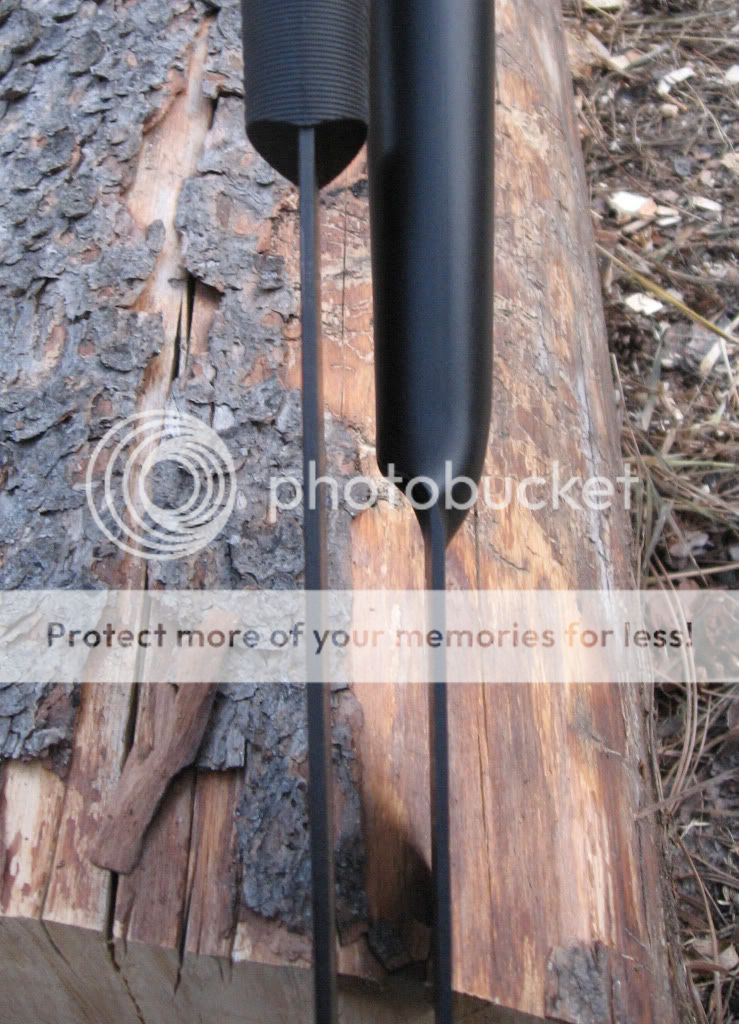
The Bushman and Barong both have the same blade thickness as shown here:
The tips of both blades (the Barong is on the right)
PART THREE- Chopping and Batoning
Now for the fun stuff- chopping and batoning. Though I consider myself more of an axe aficionado, tools like these can be used for batoning if the situation warrants. They should be able to handle reasonable tasks without breaking. What I wanted to find out was how well the bigger Barong would fare against the smaller and lighter Bushman in chopping and batoning and if the extra weight would be worth it.
For demonstration purposes, I grabbed a big 9 inch seasoned and knotted Douglas Fir log, pretty much a nightmare to split even with a big axe. The selection of this kind of log may seem extreme, but I've been in situations where I camped or hiked in more well-used places and the only firewood around was larger logs like the one shown in the picture below. The Bushman's normally large 7" blade is simply out of its league with a piece like this and could only be used to take off very small pieces from the outer edge at best.
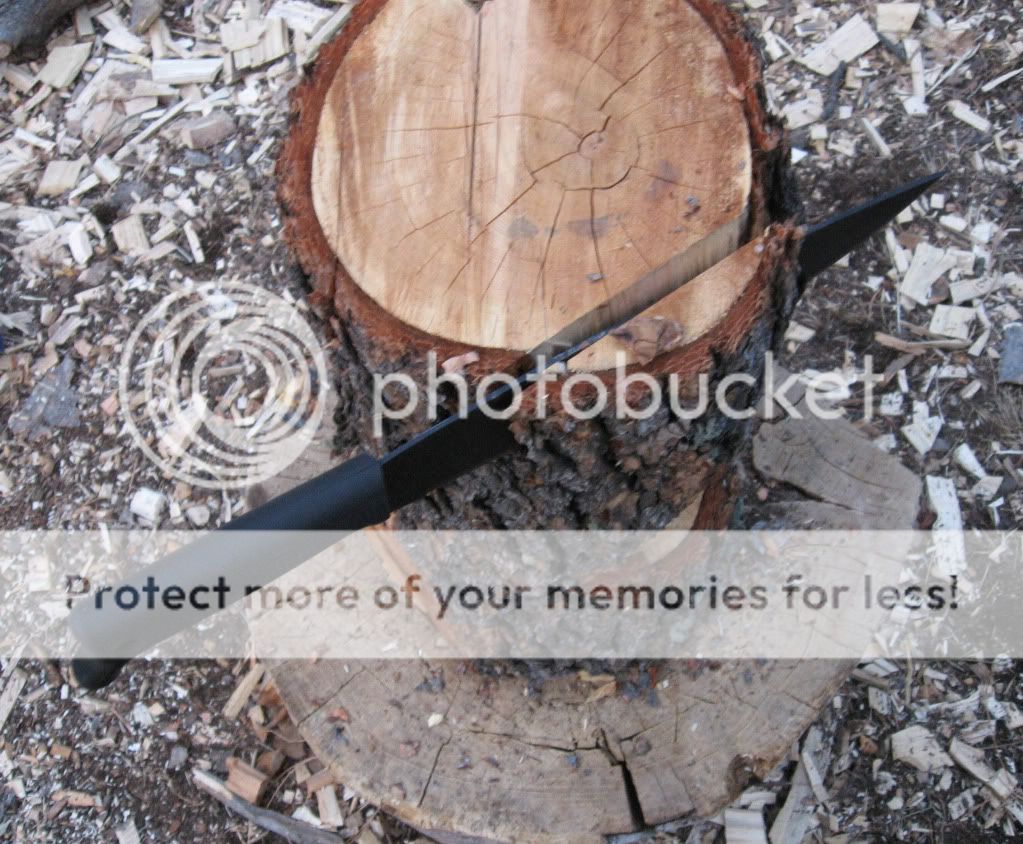
In attempting to baton this log with the Bushman, note that even at the edge of the log, there is very little metal to strike with a baton:
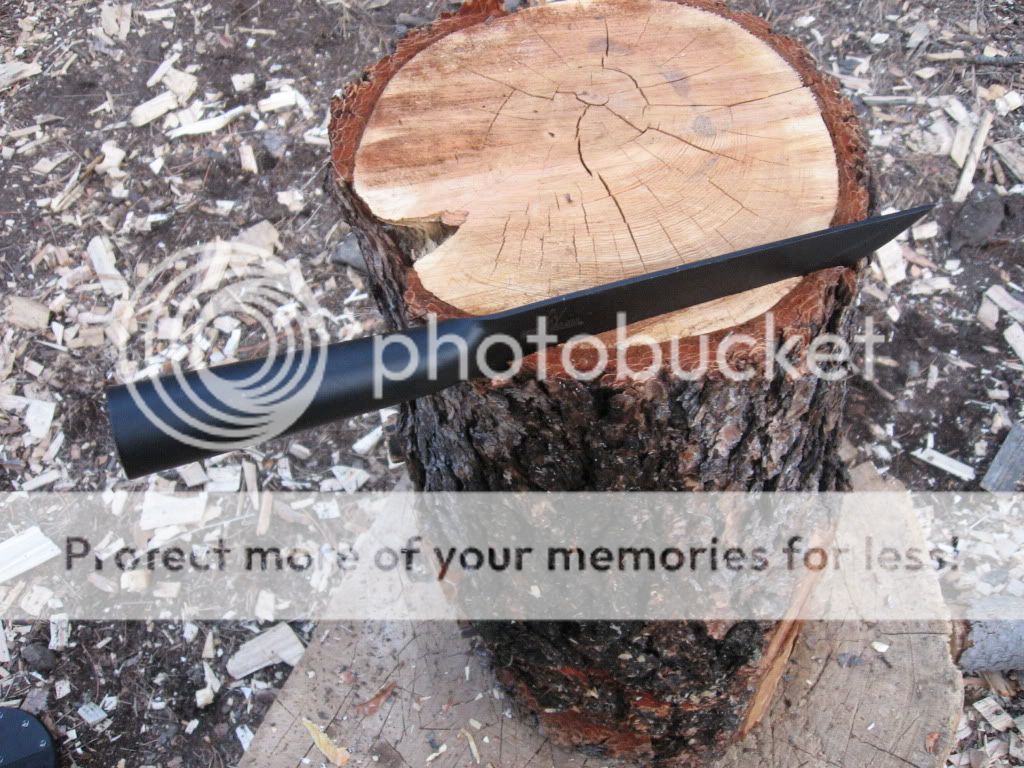
By comparison, the 12" Barong Machete dominates the log and has plenty of exposed metal on the back of the blade to baton with:
Though the Barong is pictured in the middle of the log, I would never attempt to baton through something as big and knotted as this as it would probably destroy the blade if attempted (I have before and lost!).
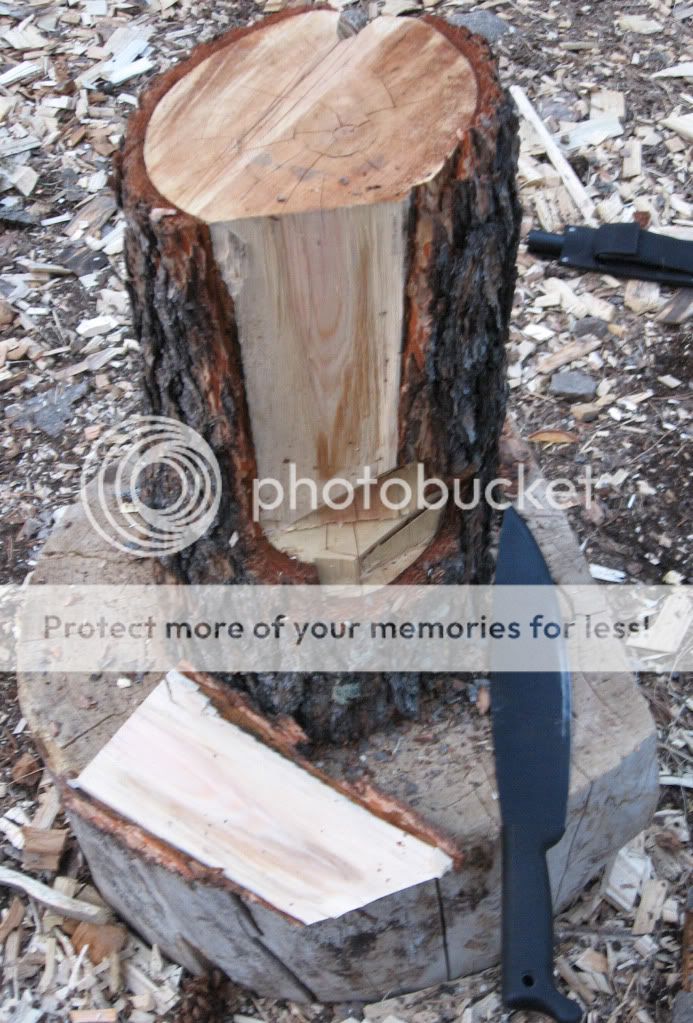
Instead, take a piece from the outer log, which is easier on the blade:
The Fir slab was easily reduced into kindling with the Barong, and to test the cutting capabilities, I created a featherstick with it:
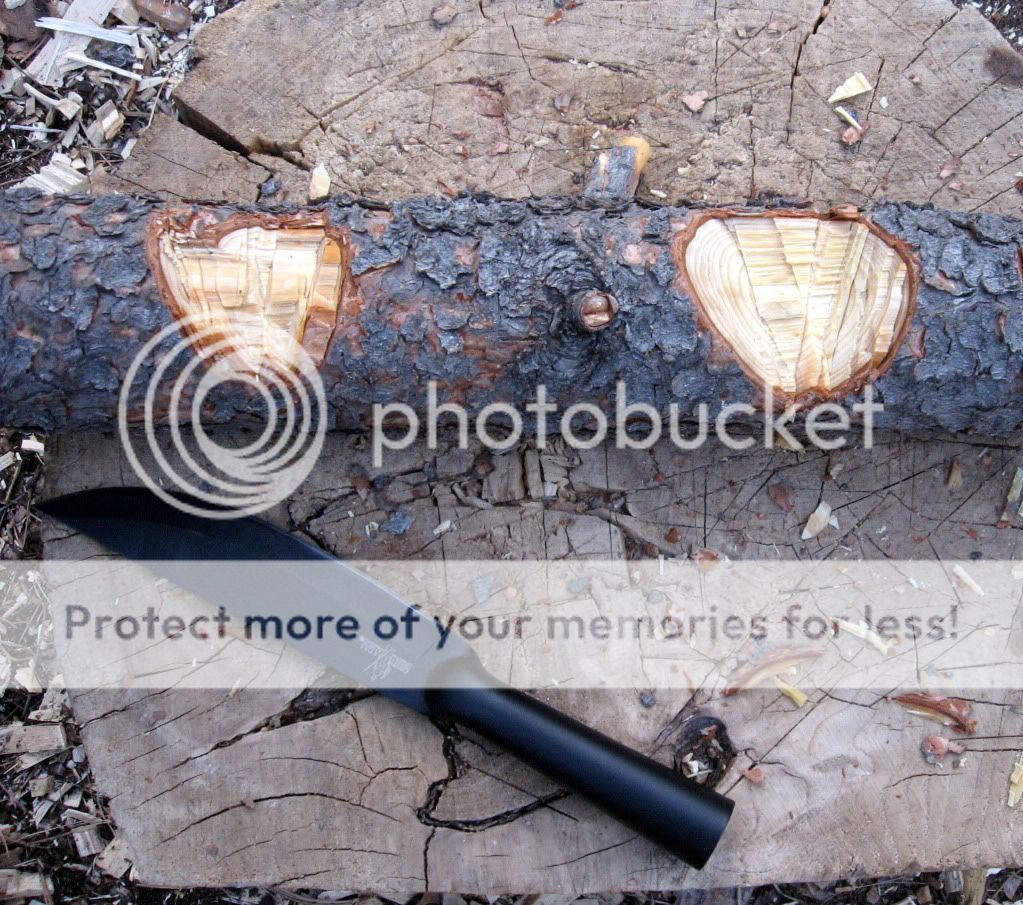
To test the chopping capabilities of each blade, a small Douglas Fir log was used. On the left is the Bushman after 25 chops and on the right is the Barong notch after 25 chops. Clearly, the Barong is a more powerful chopper. The angle of the photo doesn't show the depth of the Barong's chopping notch as well as I would have liked, but needless to say, the Barong chopped almost 3 times better yet weighs only 7 ounces more than the Bushman.
SUMMARY
My overall impression is that the Barong is about three times better in batoning and chopping for only a 7 ounce increase in weight over the Bushman. It also has a much more comfortable handle as well. As evidenced by the featherstick in my photos it is also capable of some of the finer work that the 7" Bushman blade can do. I've found the combo of the Barong machete, 7" folding saw plus a Mora or Swiss Army Knife or Multi-tool will cover just about all bases during most of the year (except winter, where only an axe will do!).
As a machete, it's probably not the best of the bunch, because the weight tends to be towards the center and not at the tip as in most machetes. That said, it still clears brush fairly well. I think it is more of a survival\bush machete in that it can do many things well but not perfectly, as there is always a compromise with tools of this nature.
As a defensive weapon against an animal attack, it is truly fearsome because of the combination of the sharp point, 12" blade length, and the fact that it is thick enough to have power yet thin enough to be extremely fast in the hand. Though I carry bear spray as my main defense, this is one tool outside of a firearm that makes me feel as if I would have a fighting chance if I were attacked. The reach, sharpness and hitting power would be devastating even to a tough animal like a bear or cougar. The way this thing takes out chunks of wood means it could easily crush or break bones, etc. I am an animal lover and hopefully will not be faced with this situation, but if it were to happen, then it's nice knowing that your bush tool might save the day.
For the money I just don't think you can beat the 12" Barong Machete. Though they were discontinued last year, they still sell occasionally on eBay for under $35, an absolute steal in my opinion. Buy two if you can, because once word gets out they will probably get more expensive as many other discontinued Cold Steel products have. An incredible value. I have to pinch myself because I can't believe I was able to buy several of these for only $7 a piece!
About the author
 Jason Schwartz is the founder and senior editor of Rocky Mountain Bushcraft. He is a former Red Cross certified Wilderness & Remote First Aid Instructor, and has taught bushcraft and wilderness survival techniques to the Boy Scouts of America, interned with the US Forest Service, and studied wilderness survival, forestry and wildland firefighting at Colorado Mountain College in Leadville, Colorado. Jason has also written for magazines such as The New Pioneer and Backpacker, including writing the "Tinder Finder" portion of Backpacker's "Complete Guide to Fire," which won a 2015 National Magazine Award (NMA). Email him at rockymountainbushcraft @ hotmail.com (without spaces)