

Until recently, mentioning the word "bushcraft" to people virtually assured that you would be met with a blank stare. "What the heck is bushcraft? You'd be asked. "Is that some Australian thing like what Crocodile Dundee did?"
Due to increased interest from the survival/prepper movement, economic uncertainty, and the rise in popularity of shows such as Dual Survival, Survivorman and Man Vs Wild, bushcraft is no longer such a strange term.
Bushcraft is an incredibly diverse melding of ancient and modern wilderness survival skills, and incorporates many different genres including Native American skills, classic woodsmanship, backpacking, Stone Age skills, and military survival techniques. Think Ötzi the Iceman meets Les Stroud, and you have a pretty good idea!
Bushcraft also emphasizes skills with simple tools, such as knives, axes and saws, or primitive tools made of stone, bone, wood or staghorn. The point is to be able to create everything you need from materials readily available in Mother Nature.
In a significant sign of this growing popularity, Benchmade Knives, a company not usually associated with bushcrafting, decided to pick up on the trend. In March of 2012, they called on their talented in-house knife designer, outdoor enthusiast Shane Sibert, to help create Benchmade's first ever bushcraft knife -- the 162 Bushcrafter.
Benchmade Bushcrafter 162 SPECS:
Blade Length: 4.43"
Blade Thickness: 0.164" (4.2mm)
Handle Thickness: 0.920"
Blade Material: S30V Stainless Steel
Blade Hardness: 58-60HRC
Blade Style: High Ground Drop-Point
Weight: 7.72oz.
Overall Length: 9.20"
Sheath Material: Brushed Full-Grain Buckskin Leather w/ D-Ring, Flint Rod Loop and Retention Strap
Class: Blue
Street Price: $170.00
Street Price: $170.00
The Knife
Milled from a solid billet of premium CPM S30V Stainless and patterned after Sibert's own custom Cascadia Bushcrafter Knife, the 162 is simply gorgeous:
(click to enlarge)


Although the Bushcrafter doesn't have a scandi grind like most bushcraft knives, Sibert worked directly with Benchmade's engineering team to ensure that the edge was suitably thin before the sharpening process, then added a secondary bevel to it. This results in an edge that, according to Sibert, "increases edge strength over a scandi grind, while still being super sharp."

The handle scales are molded G-10, and are held in place with flared titanium tubing. According to Sibert, the flared tubing helps to squeeze the handle against the tang, preventing separation during laterally applied force.
These hollow tubes also provide excellent lashing points to turn the Bushcrafter into a spear, machete, or pruning pole to reach fruits and nuts on high tree branches. The addition of red spacers is a really nice touch, and provides a pleasing contrast between the handle and the tang:


Spine Controversy
The first 500 run of Bushcrafters had spines that were unsharpened (including the one originally sent for this review), which made them unsuitable for striking a firesteel. This caused a bit of controversy in forums like Bushcraft USA, where some members were quick to criticize the Bushcrafter as a promising blade that failed to live up to its name.
After receiving our test sample back in February I was also disapointed by the unsharpened spine, so I shot an email to Benchmade's design team suggesting they fix the issue if they wanted to market the knife to bushcrafters.
Not really expecting a fast response (the Benchmade team is usually busy with many projects), I was totally surprised to receive an email from them the same day, which said a package was on its way containing a new improved Bushcrafter.
Sure enough, I received a parcel that same week with a new, sharpened spine version of the knife (check the field test section below to see how the new spine performs with a firesteel). I have to say I was impressed with how serious Benchmade was about fixing this issue.
For anyone that bought a First of 500 Bushcrafter and wants to have the spine sharpened, Benchmade is offering to reprofile it free of charge if you send it back to them.
Our "First Production" test sample with the unsharpened spine:

SHEATH
The Bushcrafter comes with an attractive, buckskin leather sheath with an attached firesteel loop. The knife is held in place with a leather strap which is secured with a metal button snap, and a D-ring is built into the sheath to attach an aftermarket dangler if desired:


A plastic liner helps to reinforce the sheath:

The firesteel loop holds a standard "Army" sized firesteel:

The Bushcrafter's sheath rides high on the hip compared to most, but this is typical of many Benchmade sheaths:

I prefer my sheaths to sit lower, so this was less than optimal for me. I was able to fix the problem by adding a $5 dangler from JRE Leather:


The dangler lowered the Bushcrafter sheath enough to clear my backpack waist strap, a big improvement:

The Bushcrafter in between the Bear Grylls Ultimate Survival Knife (top) and the Mora Black Carbon Bushcraft Knife (bottom):


Comparison Shots/Handle Profile
The Bushcrafter in between the Bear Grylls Ultimate Survival Knife (top) and the Mora Black Carbon Bushcraft Knife (bottom):
(click to enlarge)

Sheathed:

Blade Profile Comparisons
(LEFT PHOTO- the Bushcrafter next to Mora's Black Carbon Bushcraft Knife, RIGHT PHOTO- next to the Bear Grylls Ultimate Survival Knife)


Handle Profile Comparison
(Left to right- Bushcrafter, Mora Black Carbon, Bear Grylls Ultimate Knife)

Field Testing
Back in September of 2008, Benchmade learned a hard lesson with their now discontinued CSK II Survival Knife, when popular YouTube knife reviewer "NutNFancy" destroyed the edge on
a CSK II in one of his videos while limbing a green sapling. Word
spread like wildfire that the CSK II's edge was brittle and chip-prone,
and sales plummeted, ultimately leading to the CSK II being
discontinued.
Determined not to repeat this painful piece of history, Benchmade took special care in constructing the Bushcrafter to make it withstand heavy use. Their primary goal was to ensure that the S30V Stainless used on the Bushcrafter would not only have outstanding edge-retention, but also be extremely tough, easy to sharpen and chip resistant.
In order to show the public that they meant business with the construction of the Bushcrafter, Benchmade put out a series of videos just after its consumer release, which showed the knife being subjected to torture tests involving the strength of the tip, and the blade overall:
Even though these test videos lend credibility to the tough construction
methods that Benchmade employed, I took the Bushcrafter up into the
Colorado backcountry to give it my own brand of "strength testing."
Specifically, I wanted to see if Benchmade's hype would match the harsh
reality of a true wilderness environment.
To test the Bushcrafter, I focused on six specific tasks -- 1) Batoning/Strength testing the blade and edge 2) Testing the Spine with a Firesteel 3) Tip Strength Testing 4) Testing the Handle Design 5) Fine Carving Ability (i.e. feathersticks, etc), and 6) Ease of Sharpening/Edge-Holding

The TESTS!
To test the Bushcrafter, I focused on six specific tasks -- 1) Batoning/Strength testing the blade and edge 2) Testing the Spine with a Firesteel 3) Tip Strength Testing 4) Testing the Handle Design 5) Fine Carving Ability (i.e. feathersticks, etc), and 6) Ease of Sharpening/Edge-Holding
BATONING/EDGE STRENGTH TESTING
One of the popular techniques of bushcraft is using a "baton" to strike the back of a knife blade, in order to cut through branches or split open logs when neither a saw nor an axe is available.
To make sure the Bushcrafter's steel could withstand the rigors of batoning in all types of weather, I tested it in both frigid Winter temps and blazing Summer heat.
Batoning Test-- SUMMER
My warm weather baton testing consisted of taking the Bushcrafter out on a hot 95+ degree day and batoning it through the toughest, most twisted wood I could find.
Over several years of testing knives, axes, and machetes, I've found that the wood at the base of large branches on old and very large Ponderosa Pines is some of the nastiest stuff I've ever tried to split. I have literally destroyed a few knives and machetes trying to baton through this stuff during strength testing trials -- it's that bad!
I've found that any knife that can withstand splitting these logs is an excellent and reliable knife. Surprisingly, blade thickness has not been a factor in the outcome, as I have batoned through these tough branches with several thin-bladed Moras, without issue, yet have destroyed a couple of well-known makers's 1/8" and 1/4" thick survival knives trying to do the same thing!
The "evil log" ready to be split with the Bushcrafter!


The Bushcrafter's blade was literally bent during the batoning of this log due to its tough, twisted fibers, but the knife sprang back to its original shape afterwards:

Success! Note the pit in the ground just below the knife in the photo-- I
had to pound the knife so hard to split the log that it created a small
crater underneath:
(click to enlarge)


WINTER-- Batoning and Firesteel Test
Last February, for the Winter batoning and firesteel test, I hiked to a favorite test location, and used the Bushcrafter to limb a large, pitchy pine branch and then split it into useable pieces to start a fire. Using my portable Kestrel Weather Instrument, I measured a very chilly -3 Degrees F at test time.
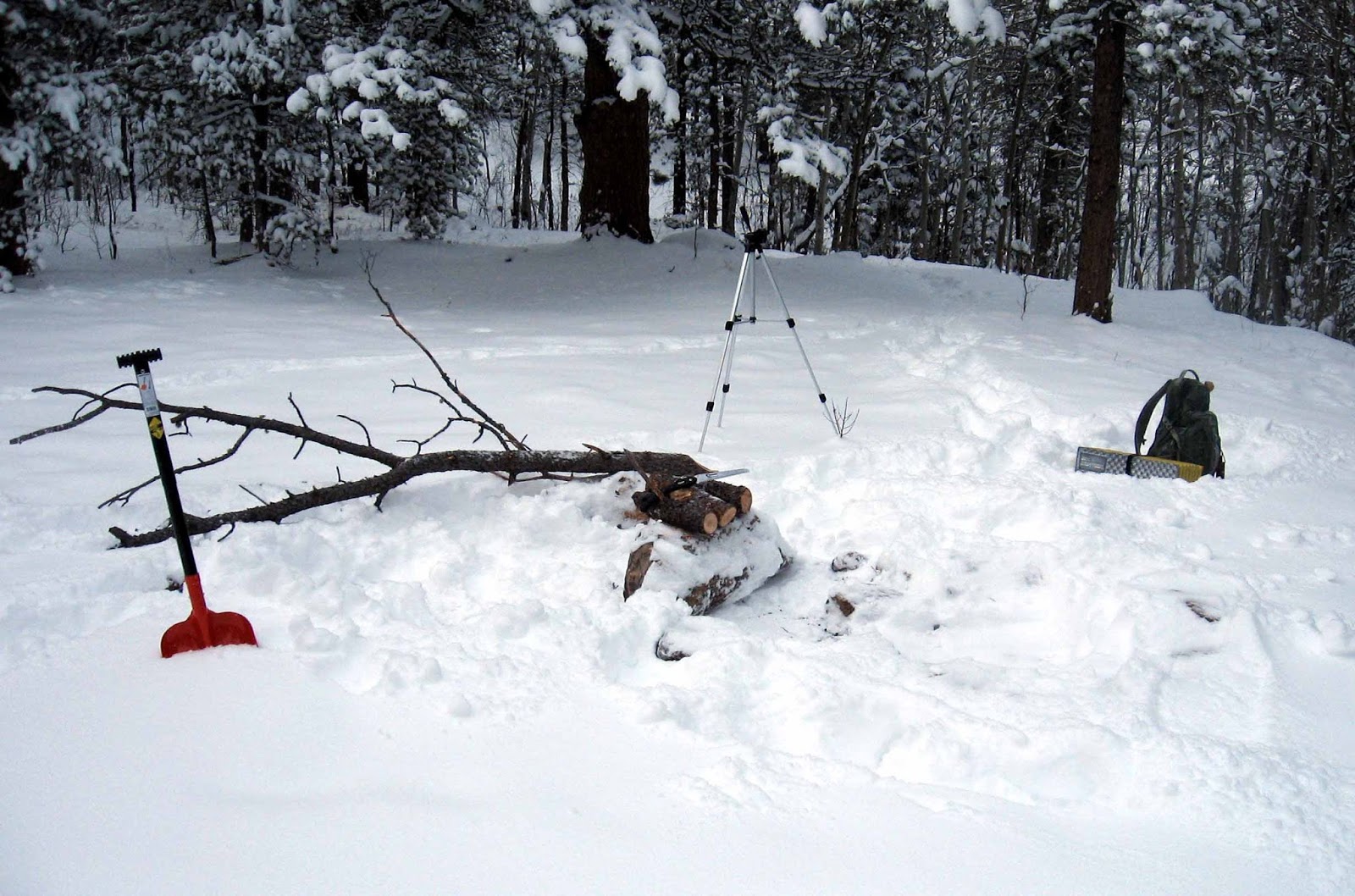
I then sawed the lower portion of the branch into three pieces:

Batoning:


FIRESTEEL TESTING
The Bushcrafter reduced the logs from the batoning test into a nice pile of tinder and kindling for the firesteel test, as shown in the photo below. No edge damage was noted from batoning, and the Bushcrafter was still hair-shaving sharp afterwards.
The prepared tinder and kindling made from the batoned
logs, all nestled nicely inside a piece of dead Aspen bark to keep them
dry, ready to be ignited:

As darkness fell, I turned off the flash on my camera to catch a more
dramatic photo sequence of the Bushcrafter striking the firesteel:


Success! The Bushcrafter threw massive sparks from the firesteel and
easily ignited the pile of wood shavings and pitchwood tinder into
flame:

This fire was then transferred to the ground to make a quick, warming fire:

Tip Strength Test
In order to test the strength of the tip, I found an old, dead Douglas Fir stump and proceeded to stab the Bushcrafter into it multiple times while twisting it back and forth. I was literally TRYING to break the tip off (hey, Benchmade told me I could get rough with it!), but the Bushcrafter's tip remained intact:

Testing the Bushcrafter's Handle Design/Fine Carving Test
The design of the Bushcrafter's handle seems to have generated controversy right from the start. Shane Sibert designed the handle to make the knife more secure while chopping (hence the swell on the end of the handle), and also to make it fill the hand better while choking up on it to make feathersticks and other fine carvings:

This unusual design has caused more than one Youtube reviewer to pan the handle, saying that people might get hot spots from it. I have not seen any of these reviewers spend an appreciable time in the field with the Bushcrafter to come up with this conclusion, so I decided to focus on this aspect in a long-term field test before posting this review.
The verdict? No hotspots on my hands during months of testing. True, the handle is not as comfortable as the handle on a Mora Clipper or Mora Black Carbon, but compared to many survival and heavy duty bushcraft blades I've tried, I found it very comfortable. In fact, I found the shape of the handle to be quite useful and innovative.
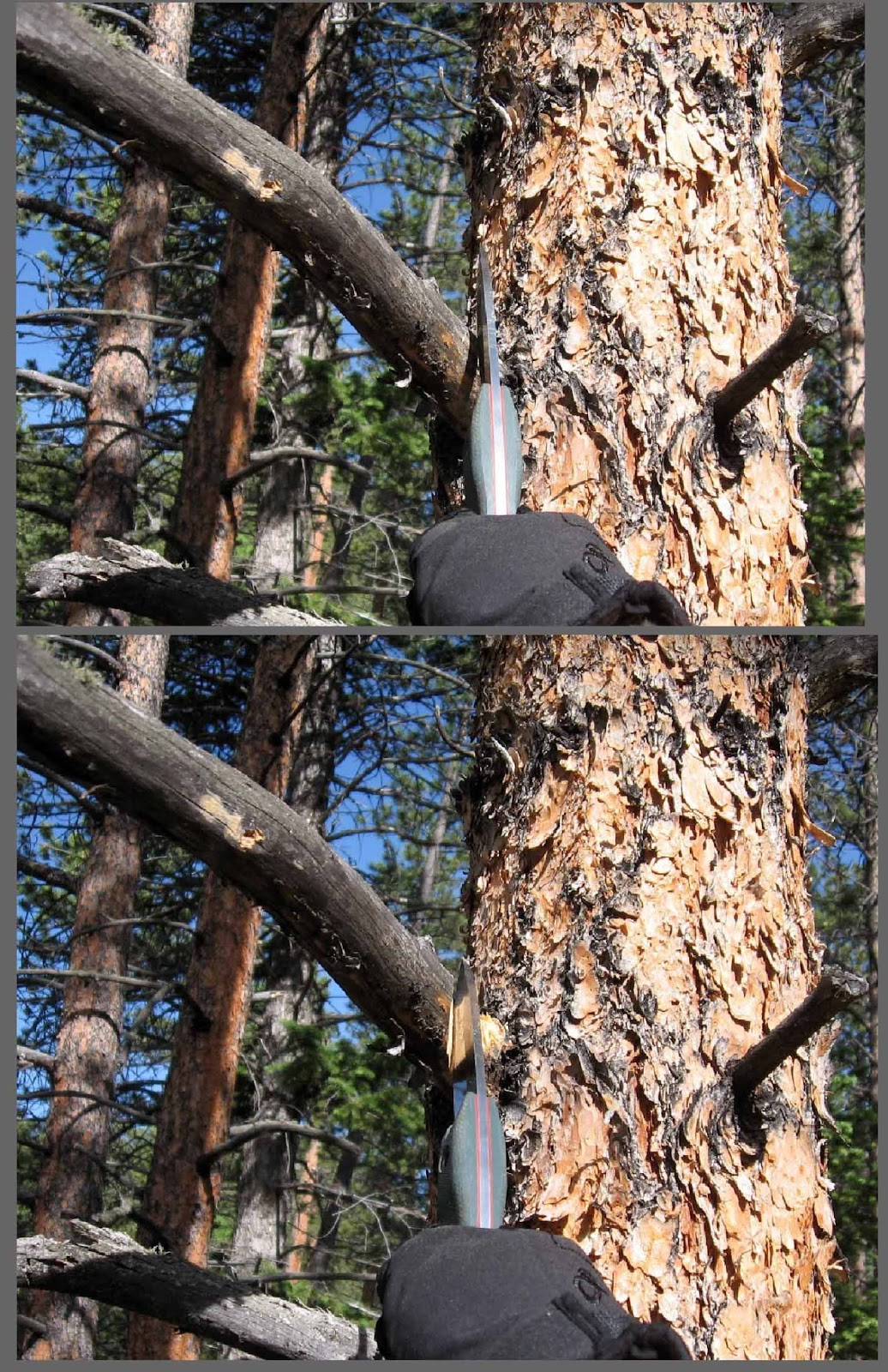
The swell at the end of the handle turns the Bushcrafter into an effective mini-hatchet for chopping, due to being able to securely hold the knife at the very end of the handle. In fact, I enjoyed chopping with the Bushcrafter, and it came in handy when needing to limb saplings for bedding material, or for chopping off pine knots to harvest pitchwood for fire-making, as shown below:

The swell in the forward part of the handle turned out to be an asset
during fine carving as well, allowing for a more secure grip when
choking up than most knives I've used (check out the Fine Carving test
below for more info).
As it turned out, the Bushcrafter's forward handle swell, coupled with Sibert's unique edge grind, proved me quite wrong. It showed itself to be a formidable fine carving blade during testing, as evidenced by the featherstick shown in the photo below:
Fine Carving Test
I've owned a lot of bush knives, including Moras, customs and
semi-customs, some with convex edges, and some with Scandi-grind edges,
so I was skeptical that the Bushcrafter, with it's more conventional
grind and secondary bevel, would perform well when it came to fine
carving tasks.
As it turned out, the Bushcrafter's forward handle swell, coupled with Sibert's unique edge grind, proved me quite wrong. It showed itself to be a formidable fine carving blade during testing, as evidenced by the featherstick shown in the photo below:


The Verdict on the Steel?
Brilliant -- the heat treat that Benchmade employed on the Bushcrafter is a certified homerun.
The Bushcrafter turned out to be as easy to sharpen as my carbon steel Moras (yes, I did say that), and I managed to get incredibly fine edges on it, sharper than any knife in my collection. Edge-retention was just as impressive. In fact, I found the S30V on this knife not only easier to sharpen than my 154CM blades, it also held an edge longer. Great job Benchmade!
Conclusion
I have to be honest and say that I was not expecting to be
impressed with this knife. Some of the Benchmade knives I've owned in
the past were hard to sharpen, and one of their early 440C survival
knife models even chipped on me while batoning a piece of wood that
should not have been a problem for the blade.
After several months of hard testing though, I have to say that this knife made me a believer.
It manages to have outstanding edge retention and takes an ultra fine edge, yet is as easy to sharpen as my carbon steel Moras. The unique grind on the knife also allows it to have a rare combination -- excellent fine carving ability along with high edge strength.
It manages to have outstanding edge retention and takes an ultra fine edge, yet is as easy to sharpen as my carbon steel Moras. The unique grind on the knife also allows it to have a rare combination -- excellent fine carving ability along with high edge strength.
Its innovative handle design allows the knife to be used more securely and effectively during chopping and fine carving, while also being very comfortable -- another rare combination.

Negatives? This is not a cheap knife, especially when compared to the
highly capable, high value Mora knives. It does however compare
favorably to similarly priced knives such as Fallknivens, ESEE, etc.
Some knife buyers might not be happy about having to add their own dangler to a bushcraft knife in this price range. Considering how cheap it is to add an aftermarket one, I was pretty baffled myself, and asked Benchmade the reason for this. Benchmade stated that they were trying to keep the consumer price from climbing too high, hence the decision to leave off the dangler.
That's certainly understandable, but maybe they could get on the horn with JRE Leather at some point and work in a factory dangler, one that would add negligible cost to the overall knife. I think this would be a better option than to force buyers to add their own dangler.
The sheath? It's not perfect, but aside from lacking a dangler, I couldn't find any major fault with it. Once I added a $5 dangler, it functioned quite nicely. I did have one issue initially - it was a bit tough to pull the knife out and re-insert it because of the stiffness of the sheath. Over time though, it loosened up. Another problem that I was initially concerned about was the sheath's plastic insert rubbing against the blade and dulling it. Over many months of field testing, I didn't find this to be an issue.

So is the creation of the Benchmade Bushcrafter a sign that bushcraft
has gone mainstream? Considering that Benchmade has had no
association with the genre in the past, their decision to design and
manufacture their own bushcraft knife is definitely a step in that
direction.
Rather than being gimmicky, it proved to be a top notch field knife that actually lives up to it's name. Sexy, super tough, highly functional, and American made, it sure made a believer out of me. My prediction is that if you try one, you'll feel the same way.
4.5 out of 5 stars (Highly Recommended)
UPDATE!- Benchmade's "Explosive" new Bushcrafter- The EOD
 Jason Schwartz is the founder and senior editor of Rocky Mountain Bushcraft, a blog that features articles, news stories, outdoor tips and product reviews written from a bushcraft and wilderness survival perspective. Schwartz is a former Red Cross certified Wilderness & Remote First Aid Instructor and has taught bushcraft and wilderness survival techniques to the Boy Scouts of America. He has also written for the The New Pioneer and Backpacker, including writing the "Tinder Finder" portion of Backpacker's "Complete Guide to Fire," which won a 2015 National Magazine Award (NMA). Email him at rockymountainbushcraft @ hotmail.com (without spaces)
About the author
Jason Schwartz is the founder and senior editor of Rocky Mountain Bushcraft, a blog that features articles, news stories, outdoor tips and product reviews written from a bushcraft and wilderness survival perspective. Schwartz is a former Red Cross certified Wilderness & Remote First Aid Instructor and has taught bushcraft and wilderness survival techniques to the Boy Scouts of America. He has also written for the The New Pioneer and Backpacker, including writing the "Tinder Finder" portion of Backpacker's "Complete Guide to Fire," which won a 2015 National Magazine Award (NMA). Email him at rockymountainbushcraft @ hotmail.com (without spaces)


