Tuesday, November 19, 2013

First Impression Review: Craghoppers Nosilife Outdoor Clothing


While I was covering the Summer Outdoor Retailer Show earlier this year, I walked by the Craghoppers' clothing exhibit, where they were showing off their latest line of Bear Grylls outdoor clothing.

When I introduced myself, I shared that Rocky Mountain Bushcraft had reviewed some of Bear Grylls' survival knives, so they excitedly grabbed me and led me over to show me their latest and greatest Bear Grylls' clothing.

With all due respect to Bear Grylls, I wasn't really interested in wearing clothing with his name and logo on it, so I asked Craghoppers if they had anything similar, but without the "BG" style treatment. The friendly Craghoppers' rep replied "certainly!" as he pulled me over to a display rack on the opposite side of the Bear Grylls line. What he showed me immediately caught my attention-- Craghoppers' Noslife line.

Craghoppers history

While many US consumers are already familiar with UK-based Craghoppers as the manufacturer of Bear Grylls' line of outdoor clothing, Craghoppers has actually been making clothing for mountaineers and outdoor adventurers since 1965.

As an innovator in outdoor clothing, Craghoppers has introduced several cutting edge features over the years, including UV solar protection, as well as permanent insect repellent that is woven directly into the clothing fabric.

Craghoppers also teamed up recently with the Dian Fossey Gorilla Fund International, which helps to protect endangered African gorilla populations. Park rangers responsible for protecting these gorillas from poachers are provided with Craghopper's permanent insect repellant clothing, which helps them ward off malaria-infected mosquitos in the Rwandan jungles of Africa.

SPECS:

Main clothing material: 100% Polyamide
Trim: 100% Polyester
Extremely lightweight and fast-drying fabric
Insect repellent technology 
UPF 40+ protection and rip stop technology
Double sun collar, cooling back neck lining and vented back
5 pockets (2 with a zip fastening large chest stash pocket, which doubles as a front vent)
Roll up sleeves with button tab
Hidden drying loops so you can hang it up to dry anywhere
Hidden security passport pocket
Country of origin: Designed in the UK, made in China

Drying loops
Pockets: 9; 2 zip-fastening
Heel tape
Elasticated waist at sides
Zip-off trousers
Ankle zips
Dry Bag & mobile phone holder in cargo pocket
NosiLife polyamide 340g
Main: 100% Polyamide, Trim: 100% Polyester
Country of origin: Designed in the UK, made in China

Nosilife Features

Craghopper's Noslife has a number of features that come in handy out in the bush. The main material is constructed from Polyamide, a synthetic nylon known for its toughness and quick drying properties. The trim is made from Polyester.

Shown in photo below: Nosilife Shirt, Convertible Pants and Nosilife Outback Hat

Drying loops are sewn into both the shirt and pants, which allows them to be easily hung from a branch when you need to dry them.


Woven directly into the fabric is a permanent insect-repellant material, which Craghoppers claims reduces insect bites by 90%. According to Craghoppers this material is safe for mammals, yet toxic to insects. Also incorporated into the fabric is a technology called SolarShield, which gives the wearer UPF40+ protection from the sun's harmful rays.

Nosilife Long-Sleeved Shirt features

Craghoppers's Nosilife Long-Sleeved Shirt is chocked full of handy features, including a mesh inner liner, air vents on the front and back, drying loops, a hidden security pocket, and lots of storage compartments.


The front vent, which also serves as a pocket:


Rear Vents:

Mesh Liner:


Hidden Security Pocket:

The shirt sleeves have button tabs to make it easy to roll your sleeves up:

Nosilife Convertible Pants features

Similar to the Nosilife Shirt, Craghoppers' Convertible Pants have several handy features, including multiple storage pockets, a dry bag in the left cargo pocket (great for keeping tinder dry), mesh pockets, ankle zips, and hidden security pockets.


                                          Side zip pocket:


The left cargo pocket has an extra pocket within, which I found handy for storing my Iphone:

The left cargo pocket comes with a removable dry bag:

Ankle zips:

The pants easily convert into shorts for hot days:


Mesh pockets:

Leah wearing women's Nosilife:

Nosilife Hats

Craghoppers also sent us their Nosilife Outback and Ultimate Hats to try out as part of this review. The Outback Hat was lightweight, comfortable and stylish when worn either "up" or "down."


The Noslife Ultimate Hat, gives "ultimate" protection from sun and biting insects, and packs completely down into a small carry bag:


Final Thoughts

Through many years of shopping for outdoor clothing, I've found it difficult to find clothes that make me look good, yet still provide field-worthy features. Craghoppers' Nosilfe seems to have what I've been looking for. These outdoor clothes are stylish yet functional, and my first impression is definitely favorable.


Of course, time will tell if they hold up to serious field use, and if their innovative features function as intended. With this in mind, I'll post an update after several months of "rough and tumble" out in the bush, and report back on my findings.

Cheers, Jason

For more information, visit Craghoppers at 
http://www.craghoppers.com/nosilife

(Thanks to RMB Team Member Monica Tymcio for taking the photos used in this review)

About the author
Jason Schwartz is the founder and senior editor of Rocky Mountain Bushcraft. He is a former Red Cross certified Wilderness & Remote First Aid Instructor, and has taught bushcraft and wilderness survival techniques to the Boy Scouts of America, interned with the US Forest Service, and studied wilderness survival, forestry and wildland firefighting at Colorado Mountain College in Leadville, Colorado. Jason has also written for magazines such as The New Pioneer and Backpacker, including writing the "Tinder Finder" portion of Backpacker's "Complete Guide to Fire," which won a 2015 National Magazine Award (NMA). Email him at rockymountainbushcraft @ hotmail.com (without spaces)

Wednesday, October 30, 2013

Review: Victorinox's new Hunter Pro Knife- Victorinox'sfirst "bushcraft" blade?


Victorinox appears to be taking aim at the growing wilderness survival market with their new and robust Hunter Pro folding knife. Sporting a one-hand opening, 4" long, 440C Stainless blade, the Hunter Pro looks to be the biggest and baddest Victorinox knife yet. 

In fact, Victorinox is making no bones about who the target audience is for this knife, as evidenced by their promo video, which shows the Hunter Pro being batoned through a log (yes, folks, the Swiss Army Knife people are actually batoning a log with this knife-- who da thunk it?!) 

Considering that Victorinox is more known for polite pocket knives than for serious survival blades, I find this quite interesting, and it's one more sign that bushcraft and wilderness survival are growing in popularity.

The SPECS:

Blade Length: 4" (100mm)
Closed Length: 5" (130mm)
Overall Length: 9" (223mm)
Locking Mechanism: Lockback
Blade Steel Type: 440C Stainless
Rockwell Hardness: 56
Handle Thickness: 0.8"
Weight without sheath: 5.7 oz (as measured on a digital postal scale)
Weight with sheath: 6.9 oz (as measured on a digital postal scale)
Made in Switzerland
Street Price: $60-$80 USD

Overview

I first got a chance to see the Hunter Pro while covering the 2013 Summer Outdoor Retailer Show back in August. Being a longtime Victorinox fan, I was intrigued. Aside from it being the largest Victorinox folder I've seen, it's also the first to incorporate a lock-back design:


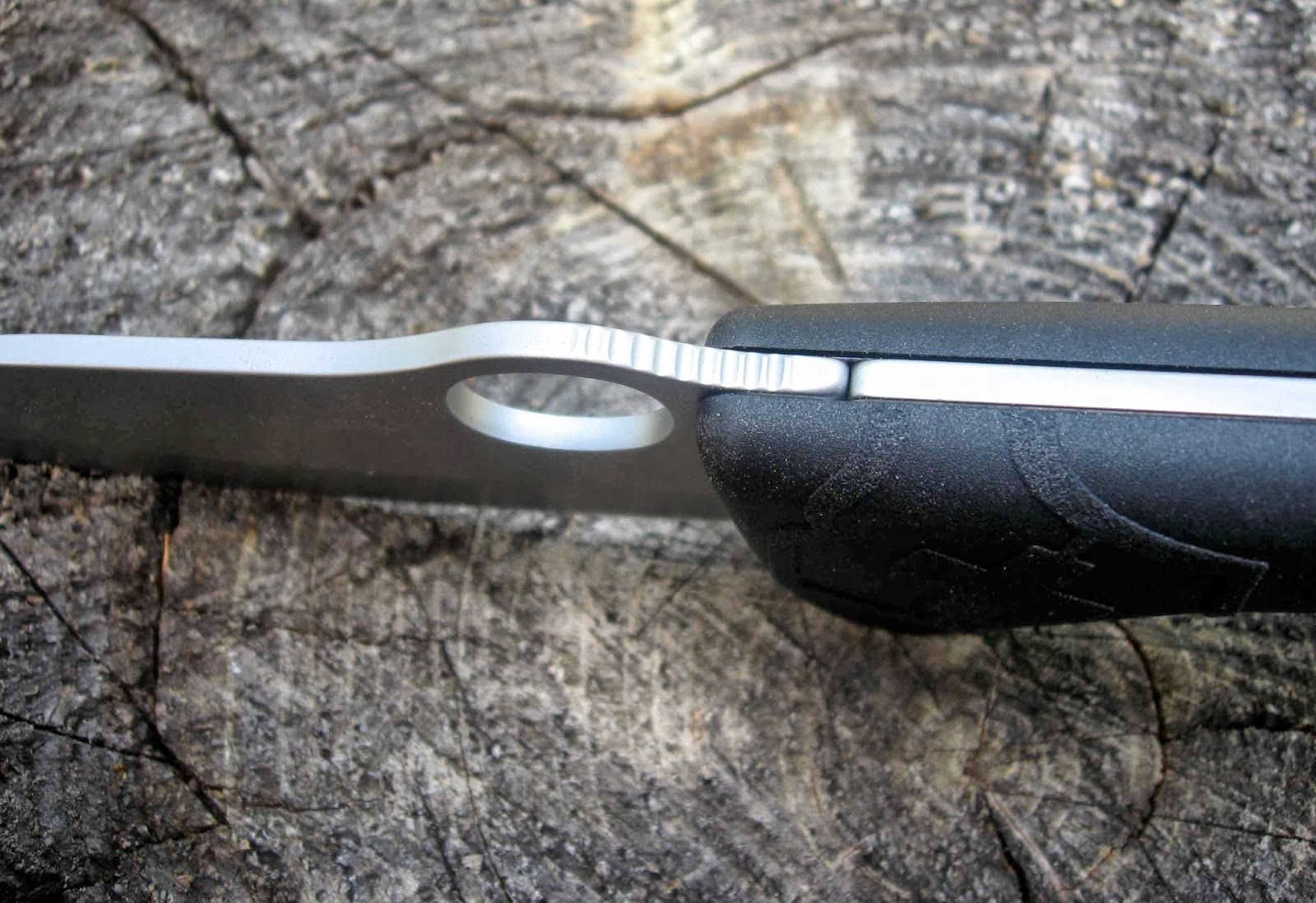
Stainless steel liners are added for strength:


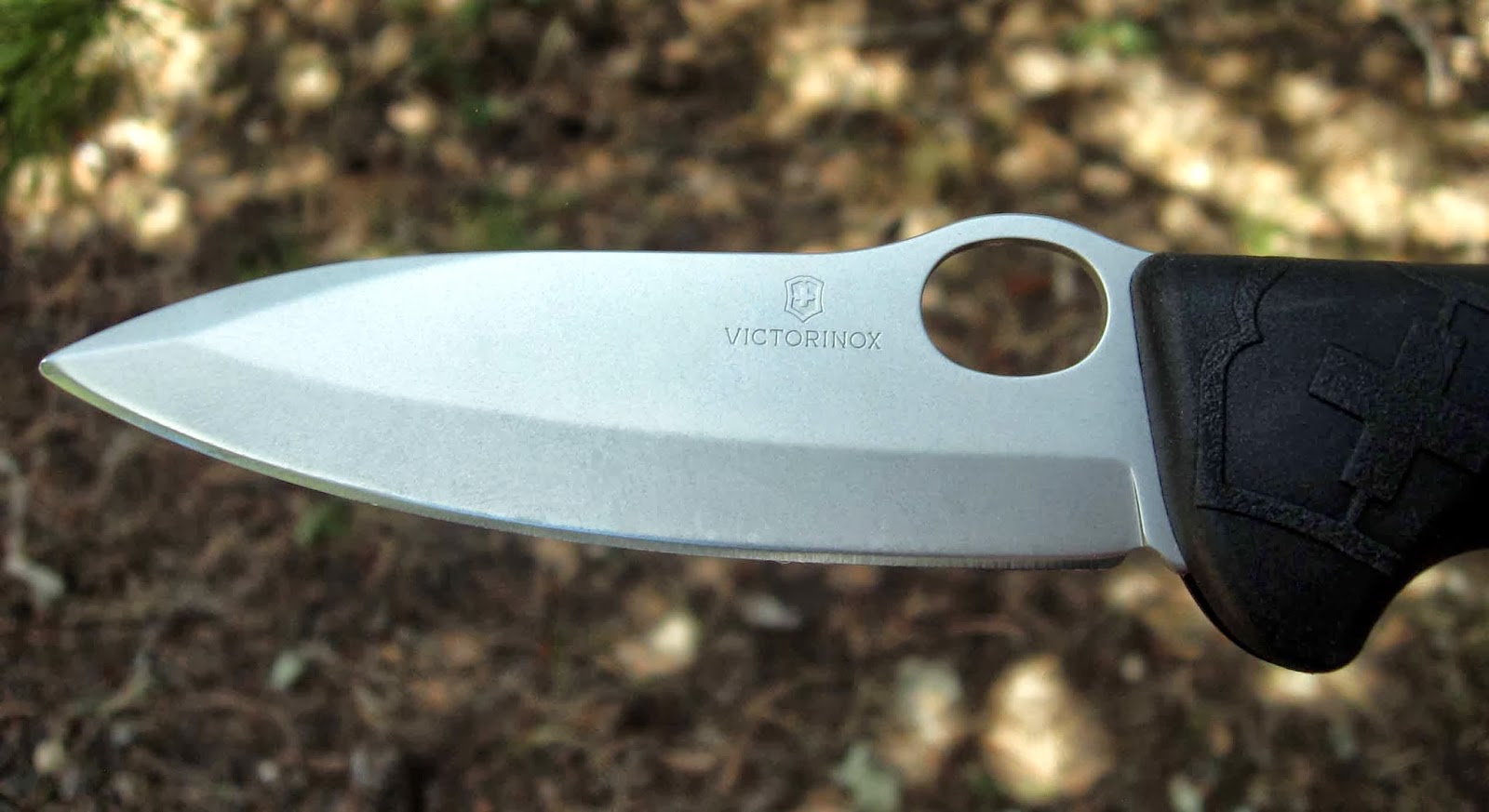
The blade shape on the Hunter Pro is a curious mix of a spear-point with a scandi-grind, and a pronounced secondary bevel. The blade has a matte bead-blasted finish, very similar to many of Gerber Gear's blades.

(click to enlarge)

The handle scales are made from a slip-resistant dual-density, hard rubber:


The Hunter Pro also comes with a nice little olive drab nylon belt case:


FIELD TEST

I ran the Hunter Pro through a battery of our standard field tests, including Fine Carving, Food Prep, Batoning and a Tip Strength test. I wasn't expecting much from a folding knife, but since Victorinox was touting the Hunter Pro as a "rugged" folding blade, I decided to go hard on it.

I was pleasantly surprised to find that the Hunter Pro actually lived up to Victorinox's hype. The handle turned out to be very comfortable and secure in the hand, and the blade's edge geometry made it an excellent fine carving knife:


The matte finish on the blade also made food prep a breeze, especially when cutting blocks of cheese, which tend to stick like glue to knife blades.


The Hunter Pro also took our rather brutal Tip Strength and Batoning tests in stride. I batoned the blade through a very knotted log, half expecting the lock mechanism to break, or the blade to chip but the Hunter Pro held up with no signs of edge damage, or degradation to the lock mechanism.

The Tip strength test yielded similar results.  I stabbed the Hunter Pro's tip repeatedly into a dry pine log and twisted it, to see if it would break, but it held up perfectly.

Unfortunately, a technical glitch with our camera's SD card prevented us from posting the photos of the batoning and tip-strength tests, but I plan to update this review with new photos as soon as time permits.

Steel Quality

In creating the Hunter Pro, Victorinox decided to go with American 440C Stainless Steel, with a Rockwell hardness of 56. I think this was a good decision, as it gives the knife a good combination of toughness and edge retention. I found the Hunter Pro a little easier to sharpen than my standard Victorinox Swiss Army Knives, yet it seemed to hold its edge better.

One-handed Opening

The Hunter Pro's blade has a large thumb hole to facilitate one-handed opening, similar to Spyderco's folding knives. Unfortunately, I found the Hunter Pro's one-hand opening a bit stiff right out of the box. I wasn't terribly surprised by this, as my experience with earlier incarnations of Victorinox's one-handed openers (i.e. the One Handed Trekker, etc) was similar. However, the Hunter Pro did loosen up enough with use that I found it to be an improvement over the One Handed Trekker.

Another minor issue was that right out of the box, there was a small amount of up and down play between the blade and the lock mechanism. Looking around on knife forums, I found this to be a common issue. It didn't seem to affect the knife in any way while batoning, but I wanted to mention it.

Conclusion

The Hunter Pro turned out to be a ruggedly built folding blade that proved its durability during our harsh batoning and tip strength tests. It was comfortable in the hand, and surprisingly good at wood carving. I think Victorinox fans who are looking for a larger, more capable outdoor knife will be well-pleased with the Hunter Pro. 

4 out of 5 Stars (Recommended)

For more information, visit Victorinox's website at: 


About the author
Jason Schwartz is the founder and senior editor of Rocky Mountain Bushcraft. He is a former Red Cross certified Wilderness & Remote First Aid Instructor, and has taught bushcraft and wilderness survival techniques to the Boy Scouts of America, interned with the US Forest Service, and studied wilderness survival, forestry and wildland firefighting at Colorado Mountain College in Leadville, Colorado. Jason has also written for magazines such as The New Pioneer and Backpacker, including writing the "Tinder Finder" portion of Backpacker's "Complete Guide to Fire," which won a 2015 National Magazine Award (NMA). Email him at rockymountainbushcraft @ hotmail.com (without spaces)

Friday, October 25, 2013

Your Axe is Your Knife!

(Courtesy of Old Philosopher at the BushcraftUSA forums)

Your Axe is Your Knife-- from the 1954 book "Woodsmanship" written by Bernard Mason

(click to enlarge)

Wednesday, October 23, 2013

Gear Review: Adventure Medical Kits "Weekender" First Aid Kit


As a Red Cross certified Wilderness & Remote First Aid Instructor, I'm often asked which "off the shelf" first aid kit is best for the field. There are many companies that make first aid kits, but of all the ones I've tried, Adventure Medical Kits seems to be the most well balanced and practical.

The AMK Weekender Kit featured in this review contains nearly everything that I would carry if I were to put the kit together myself, as well as AMK's well written Comprehensive Guide to Wilderness and Travel Medicineand a quality, well organized carry case:

(click to enlarge)

The back of the case has a convenient, easy-to-read list of contents, which makes it a much simpler task to find something when you're under the stress of an emergency situation.

(click to enlarge)

Both sides of the case also feature reflective lettering, to aid in locating first aid items under low light conditions:


The Weekender Kit, which touts the ability to treat 1-6 people for up to 7 days in the backcountry, has proven itself many times during our field testing trips. Whether treating a burn from an errant campfire ember, or bandaging a cut from the nick of a sharp axe, the Weekender has become a welcome friend in our gear packs.

For folks looking for made in the USA products, I'd note that even though some of the components in this kit are of foreign manufacture, the entire kit is assembled by American workers in Adventure Medical Kit's Littleton, New Hampshire plant.

Conclusion

Highly recommended no matter what outdoor adventure you undertake, the AMK Weekender is a high quality, well thought out product that deserves top priority next time you're shopping for a new first aid kit.

5 out of 5 Stars
(Highly Recommended)


About the author
Jason Schwartz is the founder and senior editor of Rocky Mountain Bushcraft. He is a former Red Cross certified Wilderness & Remote First Aid Instructor, and has taught bushcraft and wilderness survival techniques to the Boy Scouts of America, interned with the US Forest Service, and studied wilderness survival, forestry and wildland firefighting at Colorado Mountain College in Leadville, Colorado. Jason has also written for magazines such as The New Pioneer and Backpacker, including writing the "Tinder Finder" portion of Backpacker's "Complete Guide to Fire," which won a 2015 National Magazine Award (NMA). Email him at rockymountainbushcraft @ hotmail.com (without spaces)
Monday, October 21, 2013

Monday, October 14, 2013

Tips & Tricks: An easy way to warm your axe bit during winter


A properly tempered axe bit is both hard and tough, but the frigid temperatures of winter can make it brittle enough to chip or even break if it is not warmed first prior to chopping.

A common suggestion is to warm the blade of your axe underneath your armpit. Obviously, sticking a cold, razor-sharp axe blade inside your coat is not only uncomfortable, but can injure you or cut your clothing.

A simpler and safer way to warm your axe bit is to make a few light chops into the wood before you start chopping at full strength. This warms the blade quickly due to the intense friction of the bit striking the wood fibers.


You can then begin to chop at full power without worrying about damaging your bit.


About the author
Jason Schwartz is the founder and senior editor of Rocky Mountain Bushcraft. He is a former Red Cross certified Wilderness & Remote First Aid Instructor, and has taught bushcraft and wilderness survival techniques to the Boy Scouts of America, interned with the US Forest Service, and studied wilderness survival, forestry and wildland firefighting at Colorado Mountain College in Leadville, Colorado. Jason has also written for magazines such as The New Pioneer and Backpacker, including writing the "Tinder Finder" portion of Backpacker's "Complete Guide to Fire," which won a 2015 National Magazine Award (NMA). Email him at rockymountainbushcraft @ hotmail.com (without spaces)

Friday, October 11, 2013

Quick Review: Dave Canterbury's waterproof Pocket Survival Guides


Waterford Press sent us Dave Canterbury's series of pocket survival guides to check out recently. The eight different titles are:

Shelter, Fire, Water
Wilderness First Aid 
Signaling For Rescue
Improvised Trapping
Basic & Primitive Navigation
Improvised Hunting Weapons
Building a Survival Kit
Basic Tracking

The guides are constructed to be lightweight and waterproof. The emphasis is on surviving in the Eastern US, but much of the information is universal. Regardless of Dave's "resume embellishment" saga, I think he did a great job on these guides, as the information is sound, helpful and well written. Definitely worth consideration as something to throw in your pack "just in case."

4 out of 5 Stars 
(Recommended)

The guides are available at: www.thepathfinderstore.com/pathfinder-survival-guides-2/?sort=bestselling


Was this review helpful? If so, please stop by our Facebook page and follow us!

About the author
Jason Schwartz is the founder and senior editor of Rocky Mountain Bushcraft. He is a former Red Cross certified Wilderness & Remote First Aid Instructor, and has taught bushcraft and wilderness survival techniques to the Boy Scouts of America, interned with the US Forest Service, and studied wilderness survival, forestry and wildland firefighting at Colorado Mountain College in Leadville, Colorado. Jason has also written for magazines such as The New Pioneer and Backpacker, including writing the "Tinder Finder" portion of Backpacker's "Complete Guide to Fire," which won a 2015 National Magazine Award (NMA). Email him at rockymountainbushcraft @ hotmail.com (without spaces)
Thursday, October 10, 2013

REVIEW: Marble's Safety Axe No.5 -- Not Recommended


Blue Ridge Knives was nice enough to send us a Marble's Safety Axe No. 5 to try recently. My initial impression was favorable, since the overall quality, head profile and factory sharpness seemed very good for a hatchet in this price range.


SPECS:

Axe Blade Length: 4-1/2″ 
Cutting Edge: 2-3/8″ 
Steel: 1070 HC 
Rockwell Hardness: 50-55 
Handle material: Hickory 
Overall Length: 10-5/8″ 
Weight: 14.9 oz (as measured on a digital postal scale)
Street price: $40.00-$50.00 USD

Even though it's called a "Safety Axe," the Marbles No.5 is actually a very small hatchet:

The diminutive Safety Axe (left) next to a Gransfors Bruks Wildlife Hatchet

What makes the Safety Axe unique is the built-in metal guard that folds out of the handle and functions as a protective sheath for the blade. The metal sheath has a piece of plastic inside to protect the bit when it's folded over the blade.


Profile comparison with a Gransfors Bruks Wildlife HatchetNote the Safety Axe's uniquely shaped eye, which Marble's claims holds the handle more securely in the head:


FIELD TEST

Eager to try the Safety Axe, I grabbed it and headed off to a favorite test location. The first three swings seemed very promising, as it cut deep into the wood for a small hatchet.

The fourth swing, however, turned into a nightmare. The head literally went flying up in the air, landing just inches behind me on the ground. Had it landed on me, it would have most likely meant a trip to the emergency room.


Thinking I might have just gotten a defective hatchet, I went online and did some research. I found that fellow blogger Woodtrekker had the same issue with the head coming loose when he reviewed a Marble's Safety Axe #9 back in October of 2010.

I also found that AG Russell was selling this same hatchet under the name "Pocket Safety Axe" for the rather outlandish price of $79.95. That's some serious coin for a mass produced hatchet that's made in Taiwan.

Conclusion

If Marbles fixes the head\handle issue, it could be a nice little backwoods hatchet. The stock cutting profile and sharpness is very good. The attached guard does make the handle a little less comfortable due to the hollowed space and metal liner, but the guard is a really handy feature. It can be used to attach the Safety Axe to your belt as well.

The head/handle junction issue is a real safety hazard. There is just too much potential for serious injury, so this axe is not recommended.

1 out of 5 Stars

For more info, visit www.marblesknives.com

Was this review helpful? If so, please stop by our Facebook page and follow us!


About the author
Jason Schwartz is the founder and senior editor of Rocky Mountain Bushcraft. He is a former Red Cross certified Wilderness & Remote First Aid Instructor, and has taught bushcraft and wilderness survival techniques to the Boy Scouts of America and studied wilderness survival, forestry and wildland firefighting at Colorado Mountain College in Leadville, Colorado. Jason has also written for magazines such as The New Pioneer and Backpacker, including writing the "Tinder Finder" portion of Backpacker's "Complete Guide to Fire," which won a 2015 National Magazine Award (NMA). Email him at rockymountainbushcraft @ hotmail.com (without spaces)

Tuesday, October 8, 2013

Quick Update- Flood disaster in Rocky Mountain Bushcraft's hometown, etc

As some of you may have noticed, posting has slowed down considerably over the past several weeks. This is because Rocky Mountain Bushcraft's hometown of Estes Park was caught in the middle of the Colorado Flood disaster. As you can imagine, it has been a slow road to recovery.

(A creek flows through the middle of a mountain resident's yard where there once was none)

In spite of all of my preparations for an event like this, I was taken aback by the scale of it. Everyone I know was affected in some way, either physically or emotionally. Life is beginning to return to normal to some extent, but as you can imagine, it's taken time to regroup and start writing again.

I look forward to getting back in the swing of things, so look for a bunch of new posts/articles/reviews in the coming days and weeks, and please stop by the Rocky Mountain Bushcraft Facebook page and hit us up with a "Like", as we will be posting a lot of extra material there.

Cheers,

Jason

PS- During this period, several readers wrote us to ask if we were ok-- thank you--we really appreciated hearing from you!

PSS- This is footage of the flood destruction in the mountain town of Glen Haven. The mountains that surround Glen Haven are where we do some of our axe testing: