Last year, I came across a knife destruction video by the Dutch Bushcraft Knives Channel while surfing Youtube. In the video, they tried to destroy a knife with a name that was most certainly NOT easy to remember - the "Terava Jaakaripuukko" (try pronouncing that with your friends at your next bushcraft gathering!).
The knife is a 5.5" high carbon 80CrV2 Finnish military survival knife sold by military surplus outlet Varusteleka of Finland. Some of you may be familiar with Varusteleka because they sell a ton of hard to find European military surplus gear to bushcrafters in the US, Canada and the UK.
Now, I have seen a lot of destruction videos in my time, but this one took the cake. These two crazy Dutch knife reviewers pounded, with a hammer, the Terava Jaakaripuukko blade through a cinderblock, wetstones and mild steel tubing. No problem.
Then, they hammered the tip into hard dead wood and tried to break it off repeatedly. Again -- no problem.
Finally, the Dutch duo hammered the knife sideways into a log and then the big guy, who is built like a viking, stood on the blade and BOUNCED on it to try and break it. NOTHING.
Not happy with their results, they then SHOT the blade several times -- NOTHING.
Finally, they just decided to set it on fire briefly. Again- NOTHING, except some singeing of the rubberized handle.
Here's the video:
I also found another Youtube video from Austrian Army Veteran Joe X. In the video, Joe agressively tries to break the tip on the Terava but was unable to break it. Check it out:
After seeing these videos, I thought "Man, I have to get one of these to test!!" So I contacted Varusteleka and they were kind enough to send me a sample to try out.
The SPECS:
Weight (w/o sheath)- 190 g 6.70 oz
Total length - 270 mm 10.6"
Blade length - 140 mm 5.5"
Blade thickness - 4.20 mm 0.17"
Edge angle - 23°
Steel - 80CrV2, 59 HRC
Street Price - $47.99 USD without sheath, $82.99 with leather sheath, and $87.99 with a kydex sheath
The Terava Jaakaripuukko Survival Knife is a joint venture between popular Finnish based military surplus internet store Varusteleka.com and Finland's leading knife blade manufacturer Laurin Metalli.
Varusteleka has become well known in the American bushcraft community for offering hard to find, high quality European military surplus for less than $10 shipping to the US.
The origins of the Terava Jaakaripuukko Knife are best explained by this comment from a French member of Blade Forums USA who goes by "Schwep." His explanation is helpful and interesting, which I edited for clarity to account for the French-English language difference:
"In Finland, most infantry are called jeager or ranger troops. It's meant to be a general utility knife for conscript soldiers (and civilians) who need a sturdy knife for life in the endless forests to do camp work.
Then, as the army introduced a hybrid knife/bayonet that was actually pretty useful around camp, the soldiers 'lost' them en masse at the end of their training year, so the Finnish army stopped issuing knives or bayonets altogether and instead asked all recruits to bring their own knives. This caused a market for military-styled puukko knives like the J.P. Peltonen M95and M07, in uniquely designed sheaths suitable for upside-down carrying on tactical harnesses.
Surplus shop Varusteleka in Helsinki sold those knives, but due to a very limited production, they were always out of stock so they decided to design their own take on such knives, which were the 110 and 140mm versions of the (Terava) Jääkkäripuukko. Which, in turn, quickly became so popular they they are sold out more often than not.
These knives are made by Laurin Metalli, a reputable maker of Puukko blades."
As you can see from Schwep's explanation, it was designed for soldiers of the Finnish Armed Forces who require a knife that is tough enough to be thrashed on while being nimble enough for wilderness tasks in Finland's "endless forests."
FEATURES
The Terava 140 features a 5.5" high carbon 80CrV2 blade at a Rockwell hardness of 59. It has full tang construction with an exposed pommel that has a hole in it to accomodate a lanyard. The handle is made from a comfortable, non-slip rubber.
The blade's design is a Scandi grind with a secondary micro bevel for edge strength.
The back of the blade is sharpened for striking firesteels and scraping tinder.
The leather dangler sheath features both stitching and rivets and has a sturdy plastic liner to prevent the blade from puncturing through. It has a unique button snap blade retention system that is very secure but easily disengaged by using your thumb to unlock it.
FIELD TESTING & COMPARISON TO THE COLD STEEL SRK
As noted in the title, my first impression of the Terava was that it reminded me of the original 1990s era Cold Steel SRK in Carbon V. The Carbon V SRK was one of the greatest mid-size survival knives ever made in my opinion. It had a stout tip and blade, simple but effective sheath, comfortable rubberized handle, great all around blade shape, and best of all, steel that was tough yet very easy to sharpen and held a good edge.
At this point you may be thinking "But Cold Steel still makes the SRK, including one made from High Carbon SK5 Steel. Why is the newer SRK not as good as the original Carbon V?"
Plainly speaking, the newer SRK in SK5 is just not as robust as the original Carbon V or as easy to sharpen. It has a thin tip (see the comparison further below) that breaks too easy and the steel, although decent, is harder to sharpen and does not take as fine of an edge in my experience. The AUS8 version of the SRK is better (I've owned two of them) than the SK5 version, but it is no longer made.
By comparison, the Terava has all of the features of the original Carbon V SRK, so I wanted to do a direct comparison before commencing field testing.
Terava 140 vs the Cold Steel SRK
Unfortunately, I no longer own any of my Carbon V SRK's, so I substituted one of them with a newer SRK in High Carbon SK5 steel for the comparison.
Comparing the two, although the blade styles are different, they have a lot in common for their intended purpose of military use and survival tasks -- thick, rugged blades, beefy rubberized handles, and highly secure sheaths that are capable of safely retaining their blades in the event of a fall.
The Terava's blade is slightly shorter at 5.5" vs the SRK's 6" length. The SRK has a bowie shaped blade with a sabre grind and the Terava has a Scandinavian grind with a small secondary bevel. The Terava has a full tang with an exposed pommel. The SRK has an enclosed stick tang that runs the length of the handle.
The Terava's tip is noticeably thicker than the current SK5 version of the SRK. The original Carbon V SRKs had much thicker tips (like the Terava). It is important to have a stout tip on a survival knfe because you may have to dig with it or pry things in an emergency (i.e. prying grubs from rotten logs, popping open a locked fuel door on a vehicle to get emergency gas during a disaster situation, etc).
The Terava's spine is also sharpened for striking firesteels whereas the SRK's is not.
Both knives have excellent sheaths for soldier duty or wilderness survival. The SRK's plastic Secure-Ex sheath is lighter and comes with slots to wrap extra cordage through. The Terava's leather sheath is heavier but quieter and does not have slots in it for wrapping extra cordage. The Terava's leather sheath definitely exudes a higher level of quality than the SRK's Secure-Ex sheath:
FIELD TEST
To see if Varusteleka's Terava knife would live up to its description, I took it high up into the Rocky Mountains of Colorado, an unrelenting and harsh environment, to test its abilities.
Batoning
To test the batoning capability of the Terava, I selected a piece of very twisted Cottonwood and split it into kindling. This piece was extremely difficult to split and some of the pieces literally broke off rather then just splitting. The Terava performed excellent during this task. Although it's a Scandi grind, from a splitting perspective, the way the Terava is ground is similar to the SRK's Sabre grind which helps to wedge the wood open as it passes through the log.
I also split several other small logs and large branch sections off camera and had the same results (i.e. excellent).
Fine Carving
Although the Terava's tip doesn't have the finesse of a thin Mora knife, it gets the job done for making bow drill divots, etc:
Wood carving- this is were the Terava really shines compared to the SRK Carbon V and any of the newer SRK versions. For such a stout knife, it carves almost as well as a Mora:
I've owned 6 SRK's over the past 2 decades. Although they cut well enough for a survival knife, they are definitely not great for fine carving tasks. The Terava really ups the ante in that it is a super tough survival knife that can handle fine carving tasks with ease.
Spine Test for Scraping Tinder and Striking a Firesteel
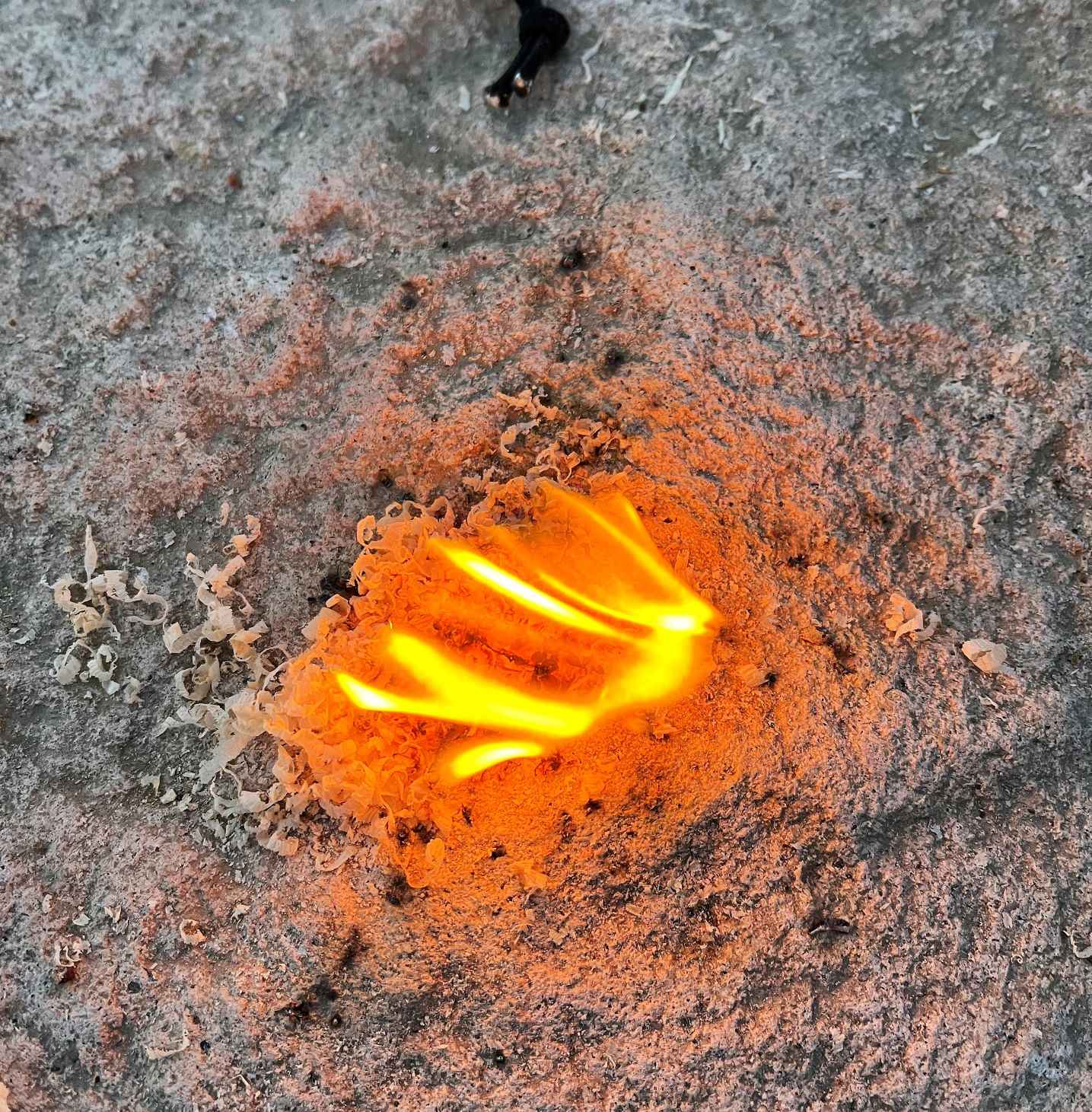
Unlike the SRK, the Terava 140 has a sharpened spine that is capable of making fine tinder shavings or to strike a firesteel to start a fire. Here, I used the Terava's spine to scrape a pile of pitchwood shavings from a Ponderosa Pine branch and ignite it with a firesteel:
Side note/survival tip- Blue medical gloves are great for keeping frostbite away while doing tasks requiring fine dexterity in extreme cold weather. They are super compact so its good to keep them stashed in your pocket and in various kits while you're out in the backcountry.
Preparing to strike the firesteel:
Success!
It is important to note that I did quite a bit of off-camera field testing of the Terava 140 before posting this review. This includes taking it with me to Rabbitstick 2022, where I assisted my friend and knife guru Lex Rule to teach a bushcraft knife sharpening course there.
I gave the Terava to Lex to try out to see what he thought of it. I won't beat around the bush -- Lex is very hard to impress when it comes to factory produced knives. But after Lex spent some time using it and then resharpening it, he pronounced "I think this is one of the best production survival knives I've used -- great steel and edge profile!"
I also used it during a one week camping trip in the Uinta National Forest in Utah on the way back to Colorado from Rabbitstick and it proved to be a great general purpose camp knife. During this time, I got to use the Terava on some harder wood like Hard Rock Maple and Scrub Oak (White Oak). The edge on the Terava held up perfectly.
CONCLUSION
So is the Terava Jaakaripuukko 140 the modern day successor to the original Cold Steel Carbon V SRK? I think so.
The Terava has a different blade style than the SRK, but in every other way, they are similar in features and in real world use. And despite my fondness for the Carbon V SRK, I think Terava has actually improved upon it with its superior wood carving ability.
The Terava's 80CrV2 steel holds an edge as good if not even better than Carbon V, and it is just as easy to sharpen. My experience with 80CrV2 being better than Carbon V were confirmed by Youtuber Cedric Outdoors, a popular knife sharpening and steel testing channel. In his video, Cedric tested a Terava in 80CrV2 and found that it held its edge better than most 1095 steels and as good as a high quality O1 Steel. That's impressive.
The Terava's tip is easily as stout as the original Carbon V if not even stronger. The Terava's handle is as comfortable, and its leather sheath is as secure as Cold Steel's Secure-Ex sheath and exudes an even higher quality.
In fact, one of the cool things I found I could do with the Terava's sheath was to turn it into an effective strop. I rubbed Flexcut Gold onto the backside and then stropped the blade back and forth on it. The shape of the sheath along with the plastic liner and quality/thickness of the leather made it an excellent platform for stropping:
I was able to quickly bring the Terava back to hair shaving sharpness using this method -- pretty cool!
Improvements? Yes, two -- 1) Add a firesteel loop to the sheath, and 2) Bring back the stainless version of this knife as an option for those who do a lot of canoeing, live near the ocean, or just want a maintenence-free knife for their bugout bag.
So if you want one knife that can perform nearly any task -- soldiering, urban/suburban survival, search and rescue or even bushcrafting, check out the Terava 140 by Varusteleka. I believe it's not only a worthy successor to the Carbon V SRK, but it has actually improved upon its concept.
4.5 Stars of out 5 Stars (Highly Recommended)
About the author
Jason Schwartz is the Founder and Senior Editor of Rocky Mountain Bushcraft. He is a US Army Veteran, former Red Cross certified Wilderness & Remote First Aid Instructor, and the author of Edible & Medicinal Survival Plants of the Rocky Mountains Pocket Survival Guides. Jason has taught at the Rabbitstick Primitive Skills Gathering in Idaho and at the Winter Camping Symposium in Minnesota. In addition, he has written articles on bushcraft and survival forBackpacker Magazine and TheNew Pioneer.
Email him at rockymountainbushcraft @ hotmail.com (without spaces)
Long popular as a high altitude backpacking and mountaineering stove, MSR's XGK EX Universal Stove is also a great choice for preparedness kits or as a cold weather bushcrafting stove.
The ability to run on almost any liquid fuel, including Diesel, Unleaded Gas, White Gas (Coleman Fuel), Jet Fuel, Kerosene, or Aviation fuel, makes the XGK infinitely flexible and economical to boot. The high heat it produces, needed to melt snow for drinking water quickly in freezing, high altitude environments, also makes it highly efficient for boiling large amounts of water for cooking in less extreme environments. This is an important feature if you're relying on Ramen Noodles for the majority of your camp or preparedness food arsenal!
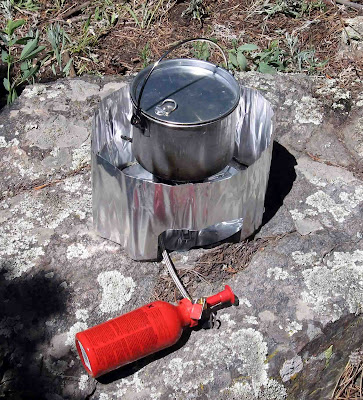
Using the XGK to boil Ramen noodles at my base camp:
The XGK's ability to use many different fuels would be a huge asset in a disaster situation. Literally any vehicle, lawn mower, tractor, train, or aircraft could be pilfered for a source of fuel to power the XGK in an emergency. This same fuel flexibility also makes it a great companion to take along on backpacking trips to Third World countries, where diesel and unleaded gas are common, but high quality white gas can be difficult to locate.
Amazing Efficiency
Another outstanding feature of the XGK is its efficiency. If you have to camp out to survive during times of economic hardship or SHTF, the XGK is much more efficient and cheaper to run than stoves that use pressurized propane/butane or alcohol. I was able to boil a large pot of water three times a day for two weeks straight, on just 0.43 cents of diesel. How's that for efficiency?!!
Fill'er up! Filling an MSR bottle with cheap unleaded gas to fuel the XGK:
The first thought that comes to mind when mentioning the word "diesel" is "dirty!," but in actuality, the XGK runs so efficient that the flame leaves virtually no soot on the bottom of your pot. The only time the flame is "dirty" is during the priming and shutdown operation. Since the pot is not on the burner during these operations, it doesn't effect it.
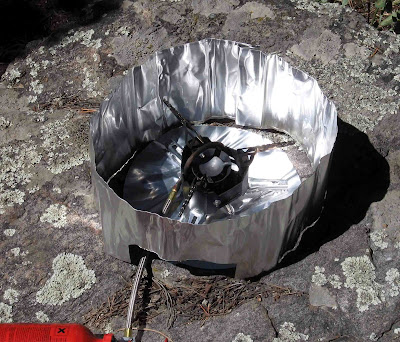
Diesel fuel burning hot, clean, and efficient in the XGK EX Stove:
The SPECS:
Proven: No. 1 choice on expeditions worldwide.
Multi-Fuel: Reliably burns more liquid fuels than any other stove.
Dependable: Easy to field maintain; Shaker Jet™ cleans fuel jet with a simple shake.
Compact: Flexible fuel line allows stove to fit in a 1.5-liter MSR pot.
Superfast: Boils 1 liter of water in just 2.8 minutes (using kerosene fuel).
Extra-Stable: Retractable legs and pot supports provide a secure platform.
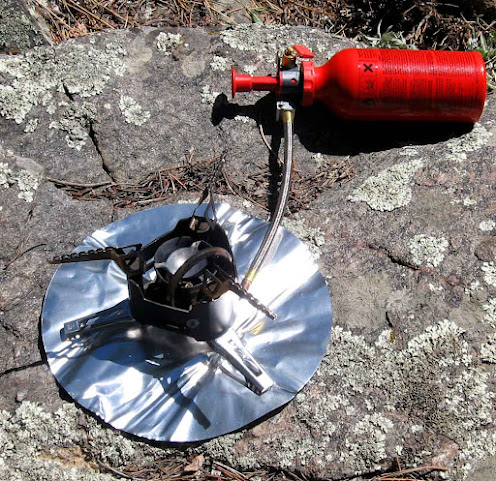
Includes: Fuel pump, windscreen, heat reflector, small-parts kit, instructions, and stuff sack. (Fuel bottle not included.)
Minimum Weight- 13.2 oz / 374 g
Packed Weight- 1 lbs 1.2 oz / 489 g
Can use these fuels- White Gas, Unleaded Gas, Diesel, Kerosene, Aviation Fuel, Jet Fuel
Burn time (white gas) per 600ml / 20 oz.of fuel- 109 minutes
Burn time (kerosene) per 600ml / 20 oz.of fuel- 98 minutes
Burn time (diesel) per 600ml / 20 oz.of fuel- 170 minutes
Boil time (white gas), 1 liter- 3.5 minutes
Boil time (kerosene), 1 liter- 2.8 minutes
Boil time (diesel), 1 liter- 4.5 minutes
Country of Origin- Made in Seattle, USA Street Price- $189.95
ACCESSORIES
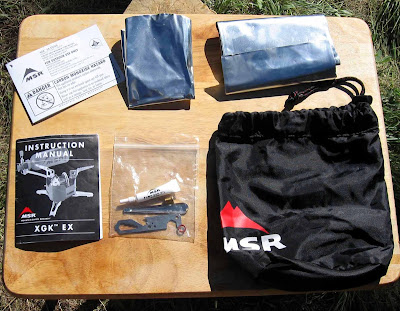
The XGK EX comes with a carrying bag, instruction manual, fuel pump, aluminum wind screen and ground protector, and a basic maintenence kit:
FIELD TESTING
Since my testing began many years ago, the XGK EX has been used heavily on backpacking trips and at my old extended base camp for boiling large amounts of snow for drinking water, boiling pasta, Ramen, heating water for washing dishes, etc. Over the course of this testing, the XGK EX has been dead reliable using many different kinds of fuels. The only problem I had was when I rushed the priming sequence once and fouled up the jet. Letting the stove cool and shaking out the jet easily fixed the issue, and the stove was immediately back up and running within minutes.
Bears Beware-- the XGK "747" is ready for take off!
Once the XGK EX is warmed up and running, it is loud compared to other backpacking stoves, sounding almost like a miniature 747 jet plane readying for takeoff. It especially gives this effect when running on Kerosene. Kerosene and Jet Fuel are pretty similar, so the XGK will burn noticeably hotter and louder when using it. Between the roar and the "jet-engine" like smell, it really gives the whole airport tarmac experience when this thing is going full blast!
A positive thing about this jet-type noise is that it seems to keep bears away when I am cooking with it. My guess is that if they happened to come by when the XGK is running, they might think they accidentally ended up at Denver International Airport!
Now that I've scared you into thinking this stove is going to blast your ear drums out, it's actually not that bad. In fact, after I used it a couple of times, I didn't even notice the sound. It actually became a bit of a companion on dark, moonless nights at my base camp, when I could hear bears roaming in the area and I'd need to boil water for tea. The bears never came near when the XGK was running. Once you're used to it, you hardly notice.
Criticisms?
Yes -- just one. The XGK EX is not adjustable to simmer. It's an all or nothing affair with this stove. But that is why it is so dead reliable -- minimal parts to break.
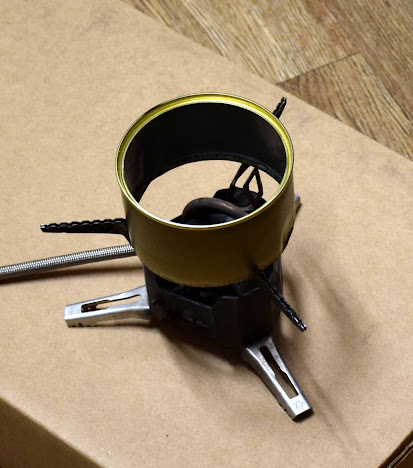
I compensated for this by using empty (steel) cans of Bruce's Yams and Great Value Roast Beef from Walmart and cutting both ends open (the Roast Beef has a pull tab on one side so you only have to cut open the bottom).
The cans sits perfectly flat on the inner ring of XGK's pot support legs. They raise the pot high enough over the flame to perform slower cooking and simmering. The Roast Beef can is a bit lower and Yam can is higher, allowing for different styles of cooking and heat intensity.
Steel Roast Beef can from Walmart turned into a riser for my XGK EX:
A can opener on a Leatherman or Victorinox works well for this task but be careful not to cut yourself -- wear leather gloves!
CONCLUSION
Whether you're prepping for a natural disaster, globe-trotting to less developed countries, or just want a backpacking stove that's flexible, reliable, and cheap to run, the XGK is an excellent choice. Plus, MSR still makes this wonderful stove right here in the good' ole USA.
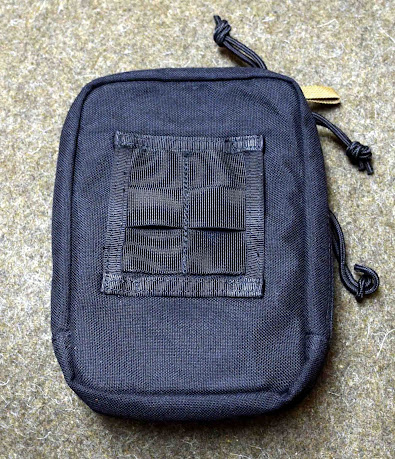
The pack has a four-way belt loop on the back so that it can be worn vertical or horizontal, as well as Molle attachment points for mounting on your pack:
The Gunpack has a pull tab on each corner to facilitate rapid opening of the gun compartment. This makes it quick and easy to open and then draw your pistol for self defense against dangerous predators.
The pack also has the ability to carry a spare mag inside the main gun compartment:
Photo courtesy of Elite Survival Systems
Since I use the Liberty to carry a bulkier Glock 29 10mm, I've found that it's a bit too cramped to carry a spare mag like this and instead, use the front outer compartment to hold the spare mag. But for those with typical 9mm CCW pistols such as Glock 43's, Sig P365's, Smith & Wesson Shield's, etc, the spare mag carry in the main compartment works well.
Final Thoughts
I've found the Liberty Gunpack to be a great CCW companion when walking or hiking in populated areas and around town, where the ability to be discreet is important. I've never gotten a second look from passerbyers while wearing it. The quality of the pack is high and the zippers have held up well to steady use. I think it is a great "Wilderness to Street" gunpack.
5 out of 5 Stars (Highly Recommended)
EDITOR'S NOTE: I would like to thank my friend Mikhail Merkurieff of Emberlit Stoves and Camp Ware for his assistance in taking the photos used in this review. Mikhail's titanium stoves, flint strikers and survival fishing gear are top notch. Please stop by and check out his website at https://emberlit.com/
A couple of years ago, CRKT stopped production of the Doug Ritter RSK Mk5, a cool little "Fits into an Altoids Can" survival knife.
For 2021, Smoky Mountain Knife Works has managed to bring them back into production. According to Doug Ritter, the knives are still made in the same factory as the original CRKT versions using the same exact steel, so the quality is identical.
However, these knives now retail for HALF the price of the original CRKT versions, with a street price of just $11.99 at Smoky Mountain Knife Works as of this writing.
You are not going to find another purpose built, Altoids Can sized fixed blade knife like this for even close to price.
Ritter and his associates put a lot of work into developing this little knife for real world survival use back in the day, which can read about at this link- http://www.dougritter.com/rsk_mk5.htm
I've owned the CRKT version for many years and love it.
Aside from the fact that this knife is such a great accessory to your micro-survival kit, buying one also helps fund Doug's KnifeRights.org, which is on the front lines battling for your right to own and legally carry knives around the country.
Cheers,
Jason
About the author
Jason Schwartz is the Founder and Senior Editor of Rocky Mountain Bushcraft. He is an Army veteran, former Red Cross certified Wilderness & Remote First Aid Instructor, and the author of Edible & Medicinal Survival Plants of the Rocky Mountains Pocket Guides. Jason has also written articles on bushcraft and survival for The New PioneerandBackpacker MagazineEmail him at rockymountainbushcraft @ hotmail.com (without spaces)


.JPG)


%20WEB.JPG)


%20WEB.JPG)



%20WEB.JPG)


 Jason Schwartz is the Founder and Senior Editor of Rocky Mountain Bushcraft. He is a US Army Veteran, former Red Cross certified Wilderness & Remote First Aid Instructor, and the author of Edible & Medicinal Survival Plants of the Rocky Mountains Pocket Survival Guides. Jason has taught at the Rabbitstick Primitive Skills Gathering in Idaho and at the Winter Camping Symposium in Minnesota. In addition, he has written articles on bushcraft and survival for Backpacker Magazine and The New Pioneer.