Colonel Trautman: "It's over Johnny, it's over!"


John Rambo: "Nothing is over, nothing!"


Ever since Sylvester Stallone ran across the big screen in the 1982 thriller "First Blood," terrorizing a whole herd of town cops and national guard troops with his custom 9" bladed do-it-all survival knife, things just haven't been the same. Knife companies at the time flooded the market with cheap Rambo knife knock-offs, leading many to believe that this was the type of knife that experts used in the bush. Flea markets today are still filled with all the leftover hollow handled Rambo replicas that were once so popular.
While it looked good in the movie, in practice, a 9" blade with a hollow handle just doesn't work as well in the field. Hollow handles are inherently weaker than full tang knives, and 9" blades, though having the advantage in chopping and batoning, are rather impractical when using a knife for more important and mundane tasks like wood carving, trap-making, skinning, etc.
Almost all of the world's wilderness survival experts recommend fixed blades of between 4" and 6", and it's not by accident. Blades in this size range are both big enough and small enough to handle most bushcraft\survival tasks with aplomb. Where the original Rambo knife got it all wrong, the new Gerber Bear Grylls Ultimate Surival Knife finally gets it right.
(click to enlarge)

The Knife
The Ultimate Knife was originally conceived back in December 2010 as a collaboration between "Man vs Wild" star Bear Grylls and famed Portland, Oregon knifemaker Gerber Gear. According to Gerber, Grylls worked with their Research and Development Team for months prior to the knife's launch. His philosophy was to take all the best features of survival knives he'd used and combine them into one.
Being a Gerber fan, he had tried many of their knives during his show, including the Gerber Prodigy. It was the Prodigy that Grylls liked most, so it was this model that the Ultimate Knife ended up being patterned after. The first Ultimate Knives were all serrated-edge versions, owing to Grylls' fondness for them on his survival blades. Due to strong public demand, however, Gerber decided to release a fine edge version for 2012. It is this new fine edge version that we will be testing for this review.
Features
As mentioned, large survival knives like the Rambo knife tend to be unwieldy when performing finer tasks like trap-making, skinning, and wood carving. The Ultimate Knife, on the other hand, has a blade just under 5", coming in at 4.8" long. It also features full tang construction and a drop point blade design. This makes it a good general-purpose survival/bushcraft blade that can handle a wide range of wilderness survival tasks.
Technical Specs
- Overall length: 10.0"
- Blade Length: 4.8"
- Weight: (with sheath): 14.7oz.
- Weight (no sheath): 11.2oz.
- Steel- Chinese 7Cr17Mov Stainless Steel
- Width- 4mm
- Country of Origin- Made in China
- Knife Features:
- Fine Edge High Drop Point Blade
- Ergonomic Textured Rubber Grip - Maximizes comfort and reduces slippage
- Stainless Steel Pommel - At base of handle for hammering
- Emergency Whistle - Integrated into lanyard cord
- Sheath Features:
- Fire Starter - Ferrocerium rod locks into sheath, striker notch incorporated into back of knife blade
- Nylon Sheath - Lightweight, military-grade, mildew resistant
- Land to air rescue instructions
- Diamond Sharpener - Integrated into sheath for on-the-go sharpening
- Priorities of Survival - Pocket guide contains Bear’s survival essentials
Knife Features
The knife comes with some interesting and handy features. A small whistle is attached to the handle via a small lanyard, and though it's anemic by most survival whistle standards, it sure beats screaming for 24 hours straight!
The handle also has a stainless steel hammer pommel built into it, good for hammering tent stakes, nails, etc. Early Ultimate Knives had an issue with their pommels breaking, but Gerber has addressed and fixed this issue.
The handle itself is coated in a non-slip rubber material. I found the handle and the balance of the knife to be very comfortable overall. I understand that Gerber and Bear Grylls wanted to ensure brand identity with this knife, but I would have liked the "BG" on the handle to be a bit more understated.
The back of the blade has a ground-down area for striking the firesteel. I found that it's also great for scraping tinder like fatwood or magnesium as well. The steel that Gerber uses is 7Cr17Mov Stainless Steel, which is essentially a Chinese version of American 440A Stainless Steel.
(click to enlarge)

In addition to the lanyard hole at the back of the handle, the Ultimate Knife also has two lashing holes in the handle guard. This can come in handy for turning the knife into a machete or a spear by lashing it to a branch
.

Sheath/Pocket Guide

(click to enlarge)

The sheath is made from military-grade cordura nylon and high impact plastic. The knife is held in place with an integrated plastic snap that locks onto the hand guard when the knife is inserted, similar to Cold Steel's Secure-Ex sheaths, and also a cordura strap at the top of the handle that's secured with velcro. During all the testing we’ve done over the last few months, blade retention was excellent, and I really like the way the knife stays securely in place while also being easy to pull in and out of the sheath.
The extra goodies that are integrated into the sheath are actually quite clever. A scout-sized firesteel snaps securely into a slot built into the front, and a diamond sharpening stone is hidden inside and exposed by undoing a velcro strap on the back of the sheath and unfolding it. The Ultimate Knife also comes with a "Priorities of Survival" Pocket Guide, which contains handy survival tips.
(click to enlarge)

The back of the sheath also has an illustration guide for commonly used emergency signals:
(click to enlarge)

The sheath just clears my overnight pack's waist strap:
(click to enlarge)

Comparison Shots
Comparison of the Ultimate Knife to an Ontario SK-5 Blackbird Wilderness Survival Knife:
(click to enlarge)

Comparison to the Mora Bushcraft Force (middle) and the Light My Fire/Mora Swedish FireKnife (bottom):

FIELD TESTING
Gerber sent us the Ultimate knife to test back in February, so we've had lots of time to put it through its paces. We've used it for food prep, making feather sticks, splitting wood, batoning off branches to make primitive bow saws, and even opening cans of vegetables with it for the camp pot.
One of my concerns with the knife was the thickness. At 4mm thick, I was rather dubious about it's ability to be a good wood carver, since my main carry knives are usually thinner Swedish Moras, which are some of the finest wood carvers out there.
In a survival situation, you're going to be making lots of feather sticks for fire making, especially if you're in a wet climate, so your knife needs to be adept at this task. Much to my surprise, the Ultimate knife turned out to be excellent at carving and feather-stick making, as as evidenced by the photo below. Gerber and Bear Grylls did an excellent job with the edge profile, so it makes performing these tasks easy and controllable.
(click to enlarge)

BATONING
Though I consider axes and hatchets as the proper tools for splitting wood, I also think that anything labeled as a "survival knife" should be able to handle batoning wood if necessary in an emergency situation. Batoning might be needed, if you need to make a fire but it's been raining or snowing and all the available firewood is wet. By splitting apart logs or dead branches, it allows you to get to the dry inner wood to make a fire.
For the test, I sawed a dry Ponderosa Pine log with my Bahco Laplander folding saw.
(click to enlarge)


Success! The 4mm wide blade made batoning easy.

Machete
As mentioned in the features section, the knife has two holes in the guard for lashing it to a branch to make a spear or machete. For the test, I decided to make a machete, because from a bushcraft perspective, a machete is more useful than a spear. Not only is a machete good for clearing a path through dense underbrush, it's also superior for limbing pine boughs off of branches for making shelters or bedding.
To make the machete, I found a dead branch lying on the ground and used the Ultimate knife to chop it to a suitable length (shown in the photos below).
Finding a suitable branch:
(click to enlarge)

Cutting up and shaping the handle:

Final fitting of the handle:

I used a section of 550 Paracord to lash the knife to the branch. For test purposes, I decided to wrap the paracord through only the two holes in the guard and skipped using the lanyard hole. I figured that if this configuration held up during my limbing test, then using the lanyard hole would add even more strength, if necessary.
The finished machete:
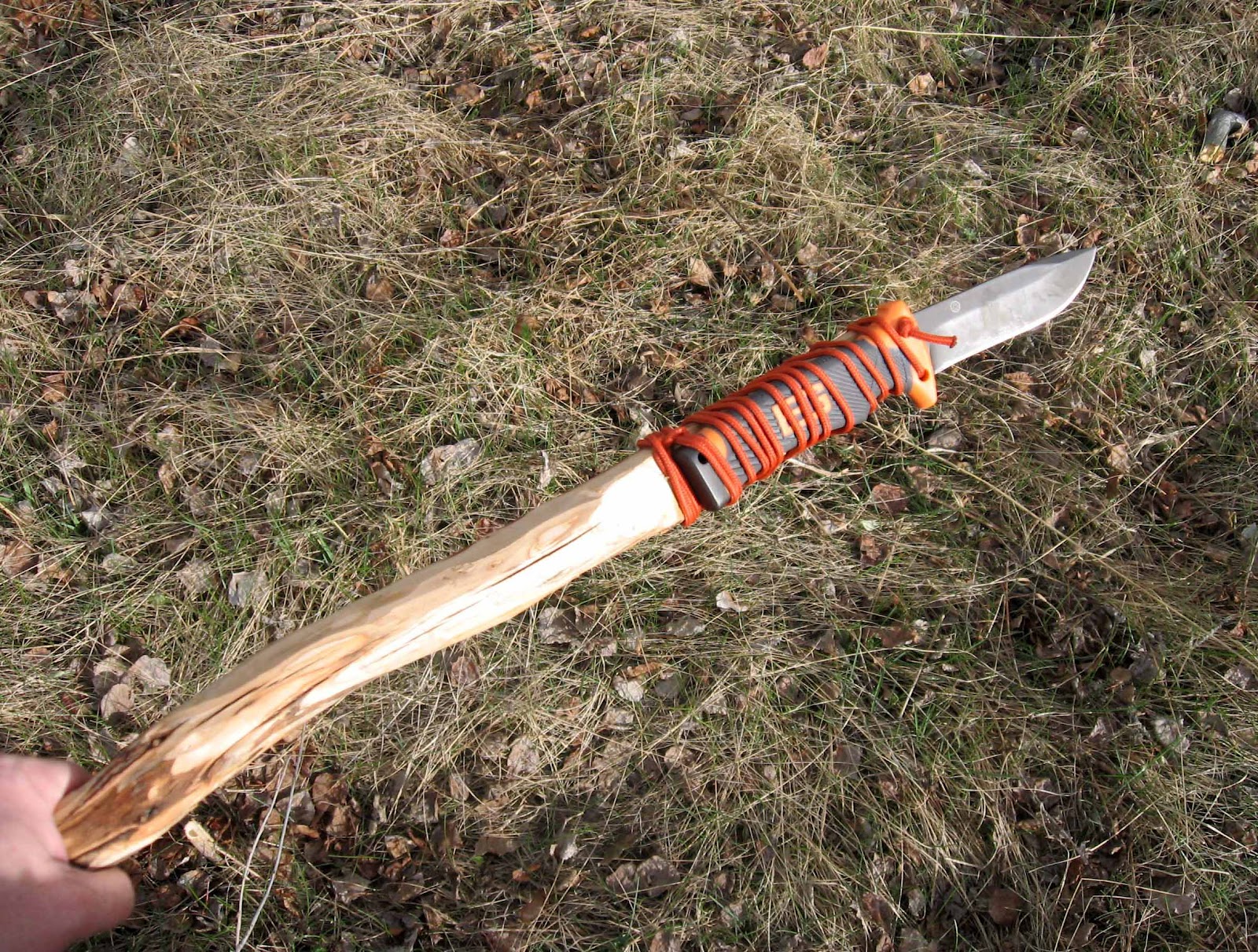
Size comparison with a 12" Cold Steel Barong Machete (bottom) and a 13" Cold Steel Kukri Machete (middle):
(click to enlarge)

The improvised machete fit into the sheath well enough that it kept the edge of the blade safe while transporting it. But it wouldn't go in deep enough to lock in place so care must be taken if you carry it this way.
(click to enlarge)

Limbing pine boughs with the machete
To test the machete, I used it to limb some pine boughs off of a recently blown down Douglas Fir tree. Though not shown in the photo, the machete was used to limb a substantial part of this tree to see how the lashing would hold up. It performed surprisingly well. The lashing held secure, and I could remove pine boughs much more efficiently than if I had just used the knife.
(click to enlarge)

This same arrangement could be used with an extra long handle to cut fruit from high branches on a tree.
Tip Strength Test
To test the strength of the Ultimate knife's tip, I jammed it into a wet log and twisted it around several times. Wet wood is especially brutal because it resists tearing more than dry wood. No chipping, rolling or deformation of the tip occurred.
(click to enlarge)

Opening up a can with the knife
Another thing a good survival knife should be able to handle is opening a can. This a distinct possibility in a survival situation, so it's nice to have a knife that can perform this task without getting damaged. In this case, I opened a can of mixed vegetables with the Ultimate knife. Just a light tap on the pommel was all that was needed for the tip to penetrate the can and open it.
(click to enlarge)

Success!

To test the strength of the hammer pommel and to further test the knife's carving abilities, I carved a tent stake out of a piece of wild Rocky Mountain Maple and then hammered it into the very rocky ground near my base camp. I had to beat this tent stake hard, and the hammer pommel didn't flinch.
(click to enlarge)

Success!
(click to enlarge)

FIRESTEEL
To test the firesteel that comes with the knife, I scraped some Ponderosa Pine fatwood into a small pile and then ignited it as shown in the photo sequences below. The knife and firesteel worked as advertised. I've also used the Ultimate knife to light my MSR canister fuel stove, and to ignite some dry grass tinder for a campfire back in late winter. Please note that all fire testing on this knife was done in late winter and early spring before the Colorado fire ban was implemented.
Scraping fatwood into ignitable tinder flakes with the notch on the back of the knife:
(click to enlarge)

Striking the firesteel into the tinder pile. I managed to get these photos right at dusk to really show the bright shower of sparks emanating from the firesteel.
(click to enlarge)


Success!
(click to enlarge)

Diamond Sharpener and thoughts on the Ultimate's 7Cr17Mov Stainless Steel
The diamond sharpener that's included with the sheath works as intended and gives the knife a sharp edge. Keeping your edged tool sharp in the field is important and actually reduces the potential of injury, because as the old saying goes, "a dull blade is more dangerous than a sharp one." When I was a kid, most serious outdoor blades came with sharpening stones on the sheath, and I've never understood why this went by the wayside. Kudos to Bear Grylls for bringing back this trend with the Ultimate knife.
Regarding the Chinese 7Cr17Mo Stainless used on this knife, it's roughly the equivalent to American 440A. This means that it's highly corrosion resistant but soft as knife steels go, so you will be using the diamond sharpener more often than you would with popular knife steels like 1095, 154CM, Sandvik, 440C, etc.
On the plus side, this softer steel is less likely to break or chip (though it could make the edge more prone to rolling under stress). Another plus is that it is more rust resistant because of the high chromium content. If you want to carry the Ultimate knife while boating or if you live in wet or humid regions of the country, this is an obvious advantage.
I would rather see Gerber use a stainless like Sandvik 12C27 on this knife. 12C27 is a Swedish Stainless Steel that's tough, yet easy to sharpen. It takes a very fine edge, and holds it well. The average person probably wouldn't notice that much of difference, but I thought I would point this out.
CONCLUSION
Admittedly, I started off this review with a rather negative bias towards the Ultimate Knife. I thought it might be just another gimmicky, over-hyped survival knife, much in the way the original Rambo replica knives were. I was pleasantly surprised to find that my initial impression was wrong. This knife actually does work well in the field.
Yes, I find that the logo is a bit overdone, the whistle is rather anemic and the steel is soft, but even with these issues, I would still recommend it to a novice, or even to a more experienced person, as something to throw in their pack "just in case." In my opinion, the overall combination of features and performance definitely makes up for the deficiencies and make the Ultimate knife worthy as a serious survival tool.
I would love to see Gerber release a more understated version as an option for the more serious wilderness trekkers out there. Preferably one with better steel (like Sandvick 12C27 or 154CM), and made in the USA like the Prodigy. Even if it were a little more expensive, I’d buy one if it was available.
Probably the greatest thing the Bear Grylls Ultimate Knife offers is a
sense of adventure. Even if you spend most of your week inside an
office cubicle, when the weekend comes, you can strap on your Bear Grylls
knife, take off for a hike, and live out your own "Man vs Wild"
fantasy for a day.
UPDATE: Make sure to check out our full reviews of the new Ultimate Pro Knife and Bear Grylls Survival Hatchet!
Was this review helpful? Please stop by the Rocky Mountain Bushcraft Facebook page and "Like" us!
About the author
 Jason Schwartz is the founder and senior editor of Rocky Mountain Bushcraft. He is a former Red Cross certified Wilderness & Remote First Aid Instructor, and has taught bushcraft and wilderness survival techniques to the Boy Scouts of America, interned with the US Forest Service, and studied wilderness survival, forestry and wildland firefighting at Colorado Mountain College in Leadville, Colorado. Jason has also written for magazines such as The New Pioneer and Backpacker, including writing the "Tinder Finder" portion of Backpacker's "Complete Guide to Fire," which won a 2015 National Magazine Award (NMA). Email him at rockymountainbushcraft @ hotmail.com (without spaces)