Showing posts with label Reviews. Show all posts

Tuesday, December 6, 2011

REVIEW: The new Fiskars X7 Hatchet- budget Gransfors Bruks killer?


Now that I've had a couple of weeks to fiddle with Fiskar's new X7 Hatchet, I wanted to write a review on it. Fiskars touts the new X-series as having a number of improvements over the older versions of Fiskars axes and hatchets, such as:

  • Better Balance 
  • Improved Chopping Performance 
  • A Hardened Bit with a hardness of 55 RC (info lifted from a reseller of the new Gerber II series axes which are rebranded Fiskars X-Series axes and hatchets) 
  • Revised handle with rubberization to improve comfort and grip retention

The X7 also has a newer style plastic sheath. It seems much sturdier than the older plastic holders which fell apart after awhile. The newer plastic model appears to be a permanent sheath solution.


The new X7 (pictured left) sports a narrower bit, a larger handle with rubberization towards the end, and is 1/4 inch shorter in length.


Here are the specs I measured on new vs old:

Fiskars X7
Weight- 22.6 ounces (without plastic sheath)
Length- 14"
Head Weight- 1.28lbs

Country of origin- Made in Finland
 
Older Fiskars 14" Hatchet
Weight- 18.7 ounces (without plastic sheath)
Length- 14.25"
Head Weight- 1lb
Country of origin- Made in Finland

Note the shallower angle of the Scandi grind on the edge of the new X7. Also, the metal from the axe head flares out more to protect the plastic during splitting chores compared to the older model. (Please note, the brighter metal along the edge is not from chopping but from my sharpening job with sandpaper and leather strop)


Older Fiskars hatchet showing closeup of wider Scandi grind and shallower transition between metal hatchet head and plastic:


Side by side comparison (X7 on left, older model on right). Also note the larger hammer poll on the newer X7, which improves the balance and the ease of camp chores like pounding tent stakes, etc.


Side by side comparison of profile of the two (X7 is on the left). Aside from changes in the cutting edge angle and the increased head size and weight, I see no major changes here other than a slightly steeper angle on the head leading towards the cutting edge.


PERFORMANCE TESTING

In testing the X7's performance, I wanted it to go head to head with one of the widely regarded standards in the field, the Wetterlings Wildlife Hatchet. I chose this hatchet over the lighter Gransfors Bruks Wildlife Hatchet because it is closer in size to the X7, including head weight (within 0.2 ounces of each other) and overall length. In fact, the X7 and Wetterlings are so closely matched that the Wetterlings sheath fit almost perfectly on the X7! I felt that if this hatchet could best the heavier Wetterlings, it was a given that it would easily trounce the lighter Gransfors Wildlife Hatchet.

For the review, I'm using a rebranded Wetterlings Wildlife Hatchet marketed under Husqvarna, as both hatchets are literally identical except for the markings. Both the Wetterlings and the X7 were sharpened to shaving sharp before testing to ensure that the results wouldn't be skewed by one having a dull blade, etc.

Here's a photo of the two side by side:


Now, on to the performance!

To measure performance, I conducted two tests, making feathersticks and chopping logs. I left out splitting because I don't think splitting performance is much changed from the older Fiskars to the new X7. The older model and The Wetterlings were about equal in my experience, so for testing purposes, we'll assume this is unchanged.

In making feathersticks, I really thought the Wetterlings would beat the X7, but to my suprise, the X7 carved a little easier.

Featherstick made with the X7:


Featherstick made with the Wetterlings:


CHOPPING

I tested the X7 against the Wetterlings by chopping 25 times each into a piece of seasoned hardwood that I picked up from a local property owner. Don't ask me what this stuff is, but it's really heavy considering that it's mostly dry! Much heavier than the Douglas Fir and Pine that normally grows up here.

This is 25 chops into it with my trusty Wetterlings hatchet:


And 25 chops with the X7. I was amazed that this crazy Star Wars looking hatchet could chop so well. Huge wood chunks flew, almost like when I chop with my 19" Wetterlings bushcraft axe! The photo doesn't really do justice to what I saw in person, but it's the best photo I could get before the snow started falling (yes, snow in April!)


NOTE- To see the X7 go head-to-head with the Gransfors Bruks Wildlife Hatchet, click HERE

SUMMARY

My impression after using this hatchet is that it's simply phenomenal at any price. I haven't used the hatchet over a long period of time so I can't say for sure if Fiskars fixed the problem with the overly soft steel on the older ones, but so far it does seem that the steel is stronger. Edge retention was as good as the Wetterlings in testing, and I even chopped into some knots just to see if the X7's edge would chip or roll. The edge has stayed perfect and is still super sharp. If this changes I'll post an update to this review.

As far as shaping wood for bushcraft tasks was concerned, i.e. tent pegs, wooden implements, etc. the X7 slightly outperformed the Wetterlings as it did with making feathersticks. This was another surprise.

As for the feel of the X7, it is much more comfortable with the new shape and rubberized handle. Handle retention is also better than most hatchets I've used. The rubberized handle portion reduces shock in addition to adding grip, so I think Fiskars hit a home run with this change.


I'm so impressed with this hatchet that I'm going to give the Wetterlings a break for a spell and start carrying the X7 in the bush, as the greater performance for the same weight just can't be denied. I'll still hang onto and use my Wetterlings since I enjoy the traditional look and feel of it, but for now, the X7 looks to be my new woods companion in the backcountry.

Was this review helpful? If so, please stop by our Facebook page and follow us!


About the author
Jason Schwartz is the founder and senior editor of Rocky Mountain Bushcraft, a blog that features articles, news stories, outdoor tips and product reviews written from a bushcraft and wilderness survival perspective. Schwartz is a former Red Cross certified Wilderness & Remote First Aid Instructor and has taught bushcraft and wilderness survival techniques to the Boy Scouts of America. He has also written for the The New Pioneer and Backpacker, including writing the "Tinder Finder" portion of Backpacker's "Complete Guide to Fire," which won a 2015 National Magazine Award (NMA). Email him at rockymountainbushcraft @ hotmail.com (without spaces)

REVIEW: Cold Steel 12" Barong Survival Machete- Bushman's Big Brother?


I've been wanting to do a review of this wonderful bush tool since ordering one on a fluke from Cold Steel last year for the ridiculous closeout price of only $7.00. I had never heard of a "Barong" machete and to be honest, the name was rather off-putting and strange to me, since I'm more of a bushcrafter than a tactical gear person. The blade shape looked useful and for only $7.00, I decided to order one to see what it was like.

What I found (to my utter suprise) was a machete that was basically a Cold Steel Bushman on steroids but with a quality, fit and finish that seemed more like a knife costing $40-$50. Needless to say, I was pretty blown away. After using the tool for the better part of a year here in the mountains, my initial impression has only grown more favorable. Since I had already owned a Cold Steel Bushman, I was struck by the fact that the Barong machete seemed more or less like a bigger version of the Bushman, so after a long winter, I wanted to post this review with that in mind.

Cold Steel 12" Barong Machete specs:
  • 12" Blade length
  • Overall Length 17.75"
  • Weight without sheath (as measured on a digital postal scale)- 16.9 ounces
  • Weight with sheath- 22.3 ounces
  • Blade steel- 1055 Carbon Steel
  • Price- Now discontinued, though some can be found on the aftermarket for $25-$50 
 
The Barong when it was new. This photo was taken last year when the weather was still warm (ahhhhh!). Note the Cold Steel logo stamped into the machete which is conspicuously absent on South African made Cold Steel machetes (like the Kukri Machetes, for instance). 


Unlike the Kukri Machete, the Chinese-manufactured Barong machete sports a higher quality sheath, with thick Cordura material similar to the Bushman's sheath. My Cold Steel Kukri Machete's flimsy sheath literally ripped open after only my first outing, but the Barong's sheath has easily handled almost a year of bush trekking with no problems. It holds the machete securely and also hangs low enough to clear a backpack strap, a big plus for me since I backpack quite a bit. I like cordura over leather for this application as it is lighter than a comparable leather sheath yet still holds the tool safely and securely.

The fit and finish of the blade is also higher than the Kukri's and this particular one came with a fairly sharp edge right out of the package. The handle material is also of higher quality, being much softer than the rather hard plastic of the Kukri and similar to the feel of the Kraton rubber on Cold Steel's vaunted SRK knife. The handle is just about perfect and it's one of the things that make this machete such a pleasure to use.

The steel is 1055 Carbon Steel, which is commonly used in machetes as well as Cold Steel's line of axes and tomahawks. It's not the greatest in edge retention but makes up for it in toughness and ease of sharpening. This machete will easily get hair shaving sharp with no effort, whereas my Kukri machete took quite a bit of work to reach this point due to the rough factory grind. It comes stock with a very efficient Scandi grind profile, similar to what the Swedish Mora Knives have. This makes it an excellent cutting tool. 

Though these machetes are built really tough, you'll need to be a little more careful when using them around rocks and tree knots due to the thinner Scandi grind edge.  That said, it is easily fixed in the field with a file and some 220 grit sandpaper. If you have the know-how, I'd also recommend that this edge be converted into a tougher convex edge at some point, like the edge on axes and hatchets. 


PART TWO- The Bushman vs the 12" Barong 
 (Comparison view of the Bushman, Barong, and 1.25lb Husqvarna Wildlife Hatchet by Wetterlings)


I already mentioned that the Barong was like a Bushman on steroids. As you can see by the comparison pic, the Barong really looks more like a big honkin' survival knife than a typical machete.  

The Bushman and Barong both have the same blade thickness as shown here:


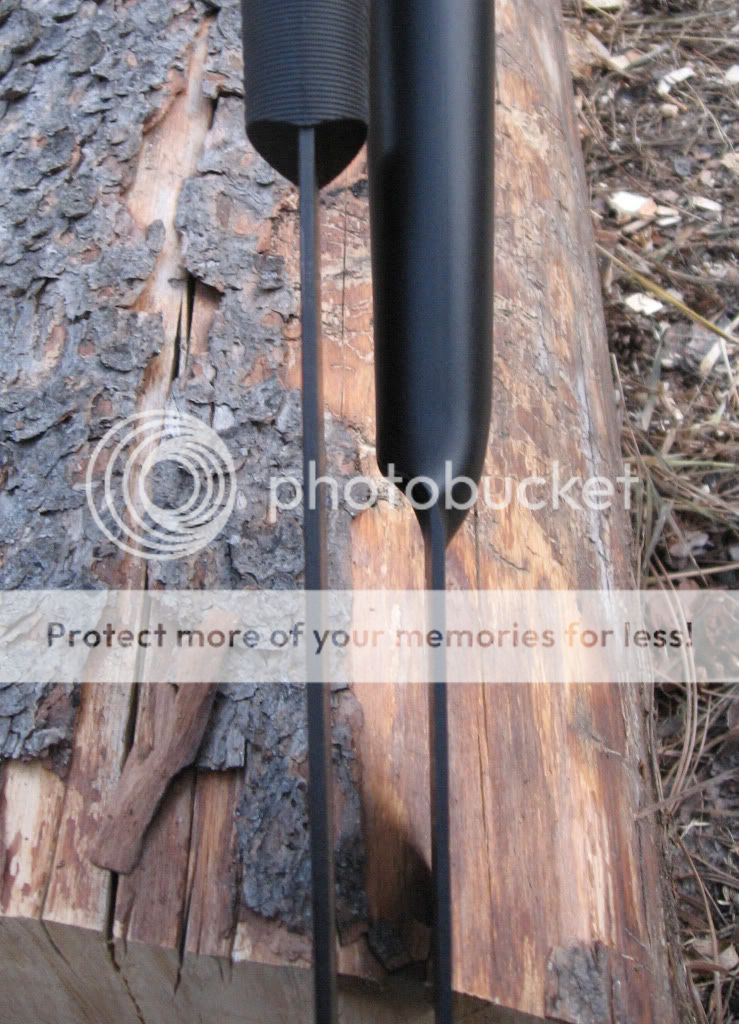
The tips of both blades (the Barong is on the right)


PART THREE- Chopping and Batoning

Now for the fun stuff- chopping and batoning. Though I consider myself more of an axe aficionado, tools like these can be used for batoning if the situation warrants. They should be able to handle reasonable tasks without breaking. What I wanted to find out was how well the bigger Barong would fare against the smaller and lighter Bushman in chopping and batoning and if the extra weight would be worth it.

For demonstration purposes, I grabbed a big 9 inch seasoned and knotted  Douglas Fir log, pretty much a nightmare to split even with a big axe. The selection of this kind of log may seem extreme, but I've been in situations  where I camped or hiked in more well-used places and the only firewood around was larger logs like the one shown in the picture below. The Bushman's normally large 7" blade is simply out of its league with a piece like this and could only be used to take off very small pieces from the outer edge at best. 

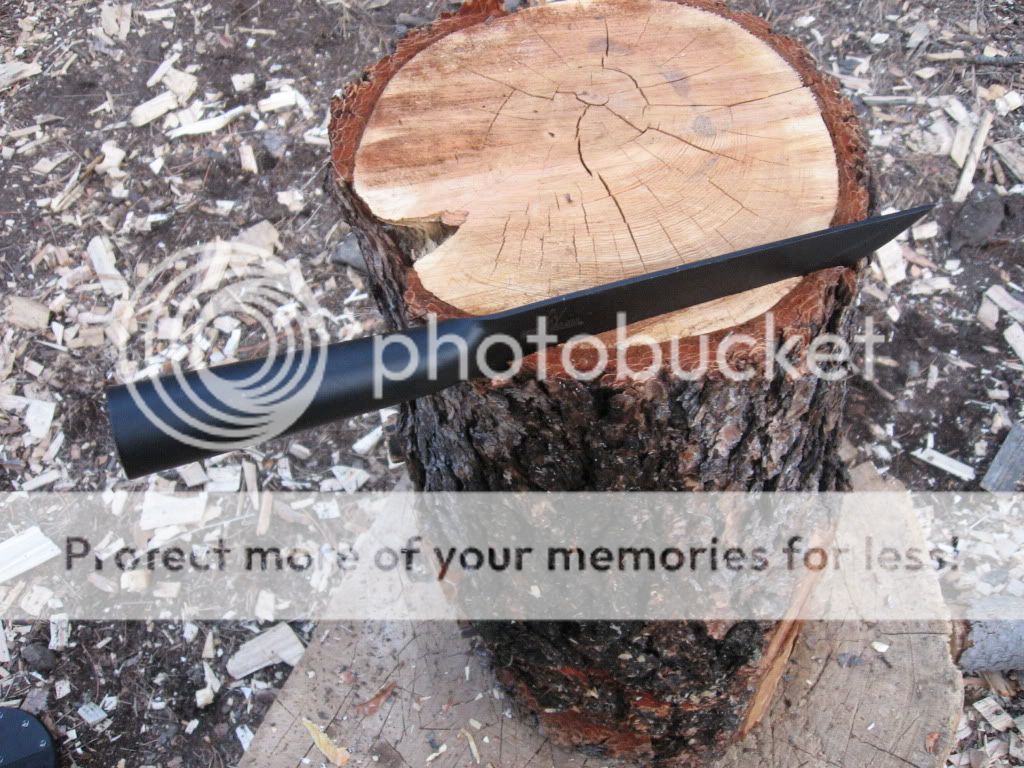
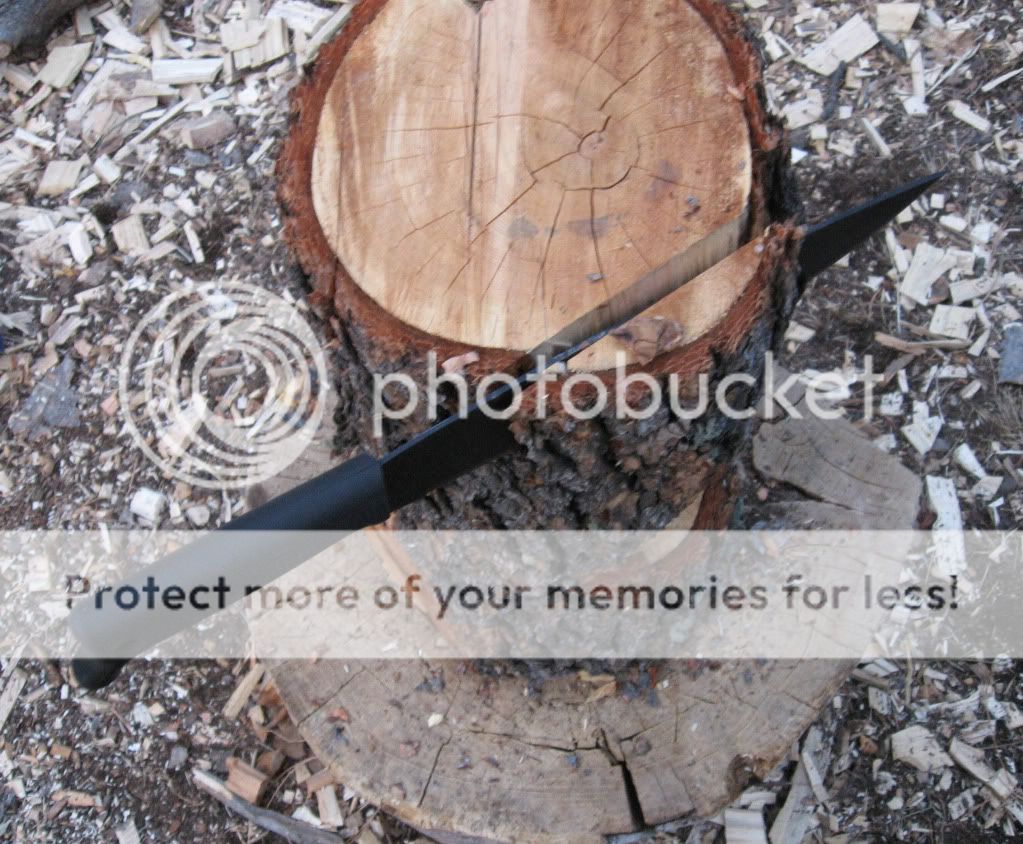
In attempting to baton this log with the Bushman, note that even at the edge of the log, there is very little metal to strike with a baton:


By comparison, the 12" Barong Machete dominates the log and has plenty of exposed metal on the back of the blade to baton with:


Though the Barong is pictured in the middle of the log, I would never attempt to baton through something as big and knotted as this as it would probably destroy the blade if attempted (I have before and lost!). 

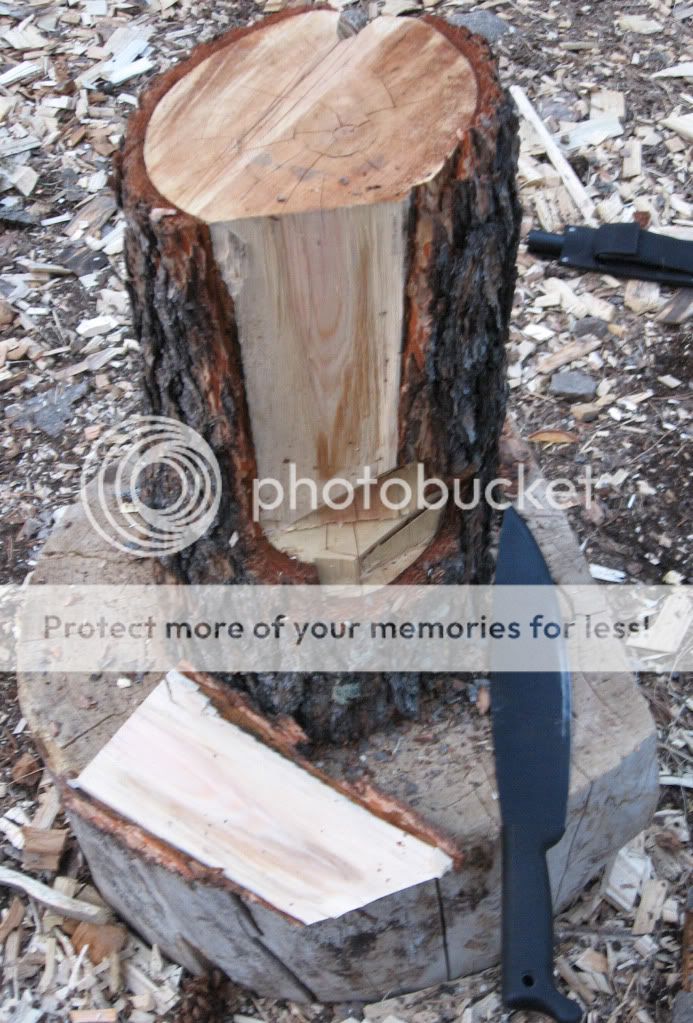
Instead, take a piece from the outer log, which is easier on the blade:


The Fir slab was easily reduced into kindling with the Barong, and to test the cutting capabilities, I created a featherstick with it:


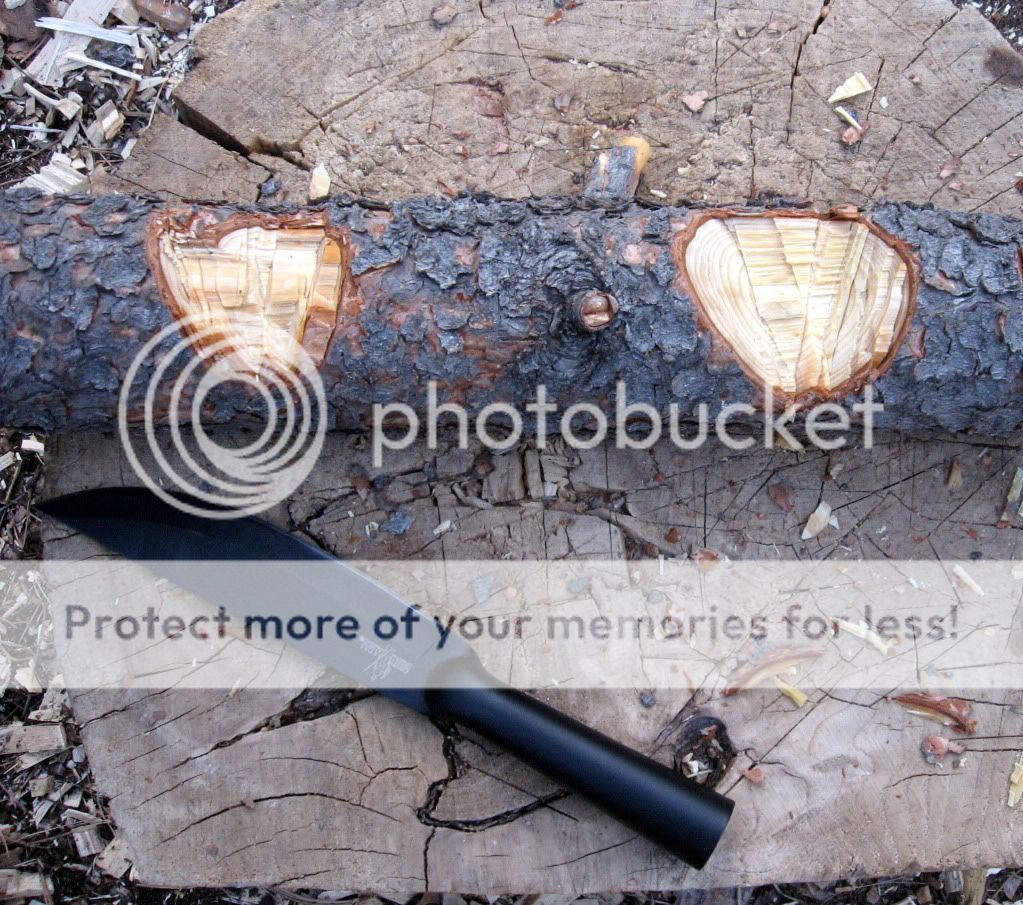
To test the chopping capabilities of each blade, a small Douglas Fir log was used. On the left is the Bushman after 25 chops and on the right is the Barong notch after 25 chops. Clearly, the Barong is a more powerful chopper. The angle of the photo doesn't show the depth of the Barong's chopping notch as well as I would have liked, but needless to say, the Barong chopped almost 3 times better yet weighs only 7 ounces more than the Bushman.


SUMMARY

My overall impression is that the Barong is about three times better in batoning and chopping for only a 7 ounce increase in weight over the Bushman. It also has a much more comfortable handle as well. As evidenced by the featherstick in my photos it is also capable of some of the finer work that the 7" Bushman blade can do. I've found the combo of the Barong machete, 7" folding saw plus a Mora or Swiss Army Knife or Multi-tool will cover just about all bases during most of the year (except winter, where only an axe will do!).

As a machete, it's probably not the best of the bunch, because the weight tends to be towards the center and not at the tip as in most machetes. That said, it still clears brush fairly well. I think it is more of a survival\bush machete in that it can do many things well but not perfectly, as there is always a compromise with tools of this nature.

As a defensive weapon against an animal attack, it is truly fearsome because of the combination of the sharp point, 12" blade length, and the fact that it is thick enough to have power yet thin enough to be extremely fast in the hand. Though I carry bear spray as my main defense, this is one tool outside of a firearm that makes me feel as if I would have a fighting chance if I were attacked.  The reach, sharpness and hitting power would be devastating even to a tough animal like a bear or cougar. The way this thing takes out chunks of wood means it could easily crush or break bones, etc. I am an animal lover and hopefully will not be faced with this situation, but if it were to happen, then it's nice knowing that your bush tool might save the day.

For the money I just don't think you can beat the 12" Barong Machete. Though they were discontinued last year, they still sell occasionally on eBay for under $35, an absolute steal in my opinion. Buy two if you can, because once word gets out they will probably get more expensive as many other discontinued Cold Steel products have. An incredible value. I have to pinch myself because I can't believe I was able to buy several of these for only $7 a piece!


About the author
Jason Schwartz is the founder and senior editor of Rocky Mountain Bushcraft. He is a former Red Cross certified Wilderness & Remote First Aid Instructor, and has taught bushcraft and wilderness survival techniques to the Boy Scouts of America, interned with the US Forest Service, and studied wilderness survival, forestry and wildland firefighting at Colorado Mountain College in Leadville, Colorado. Jason has also written for magazines such as The New Pioneer and Backpacker, including writing the "Tinder Finder" portion of Backpacker's "Complete Guide to Fire," which won a 2015 National Magazine Award (NMA). Email him at rockymountainbushcraft @ hotmail.com (without spaces)

Thursday, December 1, 2011

Council Tool Velvicut Hudson Bay Axe- First Impression


This is an initial review\first impression of Council Tool's long awaited Velvicut Hudson Bay Axe. I had hoped to get some outside photos but unfortunately, the weather in the mountains was just too blustery today to get it done. I plan to take this axe into the wilderness in the coming days and give it a serious workout, so look for my full review here sometime next week.


Specifications
Drop Forged 5160 Steel, RC 50-54
Grade "A" Hickory Handle
Length- 24 inches (this one measured in at 22.5 inches)
Weight without sheath- 43.5 ounces (as measured on a digital postal scale)
Weight with sheath- 48.5 ounces
Price- $129.95

The axe arrived in its own box within the shipping box

Opened

The box contained the axe, sheath, booklet with some history about Council Tool and axes\maintenence tips, and a little note about the Velvicut Hudson Bay. The axe also came shipped with a rubber gasket edge guard which actually fits quite well and could be used in place of the sheath if needed in an emergency.

The first thing that suprised me is how short this axe is, roughly 22.5 inches compared to Council's advertised length of 24 inches. This gives the axe a unique feel and balance, almost like a Gransfors Bruks Small Forest Axe on steroids. Maybe a better comparison is that it's like the new Ray Mears Gransfors Bruks Wilderness Axe. The dimensions and head weight are very similar, so I'll be curious to see how it performs when I get it into the back country this week


The axe did indeed come with a Grade "A" hickory handle, and the grain direction, tightness of the grain and overall quality is excellent.


Though not fully visible in the photo above, the alignment is very good, though I wouldn't call it excellent. It is better than most Wetterlings' I've seen, so I think that speaks for itself.

The profile, as seen below, is excellent and looks to be optimal for both chopping and splitting (though only a live field test will truly decide this or not). Council decided to go with a traditional metal and wood wedge as opposed to their usual single aluminum wedge to hang the head, and I am glad for this.


The wood of the handle does protude out of the eye, adding extra security against having the handle come loose, another plus. I also like that the hammer poll is ground flat and polished, making it easy to pound in tent stakes, etc.


The edge was convexed at the factory, and though it came much sharper than any axe I've bought from Council before, it still isn't as sharp as Gransfors Bruks usually come (shaving sharp). The good news is that the edge is practically done, so only light file or stone work is needed to get it optimal. The axe, in it's present form, is what I would consider knife sharp, though slightly dull. 


The axe comes with a very nice brown leather belt sheath, which includes a buckle on the backside for more attachment options. I like that the leather covers the axe when snapped shut as it adds some additional weather protection.


One complaint is that the belt loops should be made wider, as they barely fit most normal sized men's belts.


Size comparison next to a Wetterling's made 25 inch long Husqvarna Multi-Purpose Axe.


Size comparison between a 26.5 inch Council Tool Standard Hudson Bay Axe (far right) and a 19.5 inch Wetterlings Large Hunting Axe (far left)


SUMMARY

My initial impression of this axe is excellent. It looks and feels like quality, and the balance feels very good in the hand. The steel that Council uses for the Velvicut line, 5160, is quite revered in the knife community for having outstanding toughness along with good edge retention. Council feels so strongly that this axe will last that they guarantee the head for life, no kidding!

My main nitpicks are that the axe didn't come shaving sharp, a standard for Council's closest competitor Gransfors Bruks. The other issue is the size of the belt loops being slightly small on the sheath. The hickory handle could use some more cleaning up near the head-handle junction as it is a bit rough for an axe of this price, but the rest of the handle is excellent and also quite comfortable. In all fairness, Council is new to the field of high-end boutique axes, and this is a first production run, so I expect that improvements will be made over the coming weeks as they ship the next run out. Council has outstanding customer service and does read these forums, so they do take forum comments seriously when dealing with product issues.

Aside from anything else, we now have a high quality American-made bushcraft axe, and this alone is exciting. The odds were against us that this would actually come to fruition, but here it is. I want to thank all the members at Bushcraft USA and Bladeforums.com who emailed and called Council to help make this happen, and to Council Tool for being open-minded enough to actually put this idea into production. I look for forward to reviewing this axe in the field over the coming weeks and will report back with my results.

UPDATE: Check out the field review of the Velvicut Hudson Bay here

About the author
Jason Schwartz is the founder and senior editor of Rocky Mountain Bushcraft. He is a former Red Cross certified Wilderness & Remote First Aid Instructor, and has taught bushcraft and wilderness survival techniques to the Boy Scouts of America, interned with the US Forest Service, and studied wilderness survival, forestry and wildland firefighting at Colorado Mountain College in Leadville, Colorado. Jason has also written for magazines such as The New Pioneer and Backpacker, including writing the "Tinder Finder" portion of Backpacker's "Complete Guide to Fire," which won a 2015 National Magazine Award (NMA). Email him at rockymountainbushcraft @ hotmail.com (without spaces)